
What Is BPC-157? Research Guide for Australia

| Also known as | BPC 157, BPC157, body protection compound 157, PL 14736 |
|---|---|
| Sequence length | 15 amino acids (pentadecapeptide) |
| Origin | Fragment of a protein found in gastric juice |
| Studied for | Angiogenesis, gut-lining signalling, growth factors, nitric oxide |
| Research maturity | Large animal-model base; limited human clinical data |
| Found in blends | BPC-157 + TB-500, GLOW, KLOW |
| Vial sizes supplied | 5mg and 10mg lyophilised powder |
| Purity | 99% or higher, independently HPLC tested per batch |
BPC-157 vs TB-500
| BPC-157 | TB-500 | |
|---|---|---|
| Origin | Fragment of a gastric-juice-derived protective protein | Fragment of thymosin beta-4 |
| Primary mechanism | Angiogenesis (VEGF pathway), gastric/gut-lining signalling | Actin-binding, cell migration regulation |
| Secondary mechanism | Growth factor modulation (EGF, FGF), nitric oxide system interaction | Wound-margin cell mobility, cytoskeletal remodelling |
| Research origin | First studied in gastric mucosal models (early 1990s) | First studied in wound-healing and cardiac tissue models |
| Commonly combined with | TB-500, GHK-Cu (see GLOW / KLOW) | BPC-157, GHK-Cu (see GLOW / KLOW) |
BPC-157 is a synthetic fifteen amino acid peptide, a fragment of a protein found in gastric juice. That origin is why it is called body protection compound, and why so much of the research sits in gut and vascular work rather than the sports recovery context it usually gets discussed in.
This guide covers what BPC-157 is, the four pathways it is studied for, what the research does and does not establish, how it differs from TB-500, reconstitution volumes, and how to check a batch. BPC-157 is supplied by PhaseOne in 5mg and 10mg vials, strictly for laboratory research.
On this page
What is BPC-157 | What it is studied for | What the research does not show | vs TB-500 | In blends | Reconstitution | Checking purity | FAQs
Key points at a glance
- A synthetic fifteen amino acid peptide, a fragment of a gastric protein
- Body protection compound is what BPC stands for. Also written bpc 157, bpc157 and mistyped bcp157
- Studied for angiogenesis, gut-lining signalling, growth factor modulation and nitric oxide interaction
- The research base is overwhelmingly animal-model and in-vitro. Human clinical data is limited
- A component of the GLOW and KLOW blends and the BPC-157 and TB-500 pairing
- Supplied in 5mg and 10mg vials for laboratory research only
What is BPC-157?
BPC stands for body protection compound. The parent protein was identified in human gastric juice, and BPC-157 is a synthetic fifteen amino acid sequence taken from it. It is described in literature as a pentadecapeptide, which simply means a peptide fifteen amino acids long.
That gastric origin matters for reading the research. The early work looked at the stomach and intestinal lining, where the parent protein is found, and the vascular and tissue research followed from there. The popular framing of BPC-157 as a recovery compound came much later and sits on top of a literature that was never designed to test it.
What BPC-157 is studied for
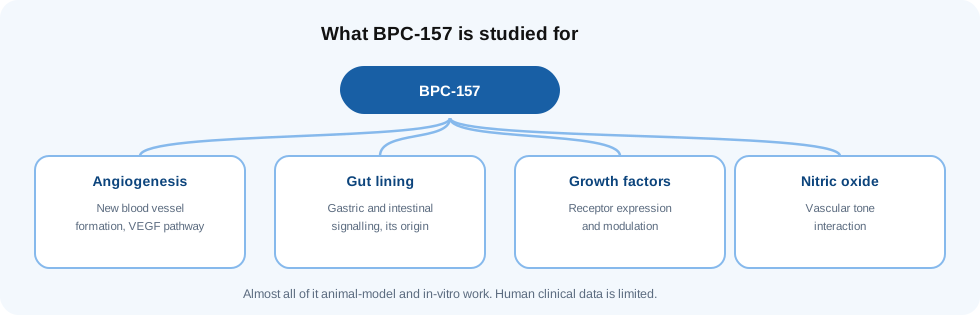
Four pathways come up repeatedly, and they are related rather than separate stories.
Angiogenesis and the VEGF pathway
The most studied thread. Angiogenesis is the formation of new blood vessels, and BPC-157 is examined for its interaction with vascular endothelial growth factor signalling. Blood supply underpins repair in most tissue, which is why this pathway sits underneath most of the other findings.
Gastric and gut-lining signalling
Where the compound started. Animal-model work has looked at gastric and intestinal lining integrity, which is the natural place to begin given the parent protein's origin in gastric juice.
Growth factor modulation
Studies have examined BPC-157's effect on growth factor receptor expression, which is one proposed route by which a single small peptide could influence several tissue types rather than one.
Nitric oxide system interaction
A quieter thread, looking at interaction with nitric oxide signalling and vascular tone. It connects back to the angiogenesis work rather than standing on its own.
What the research does not establish
This is the part usually missing from BPC-157 pages, so it is worth being direct. The literature is overwhelmingly animal-model and in-vitro. Human clinical trials are few, small and not the basis for the claims that circulate.
What that means in practice: findings in rodent tendon or gut models do not transfer automatically to humans, dose relationships from those models do not scale directly, and the absence of large human trials is a gap rather than an oversight. Anyone selling BPC-157 on the strength of outcome claims is going well past what has actually been shown.
BPC-157 vs TB-500
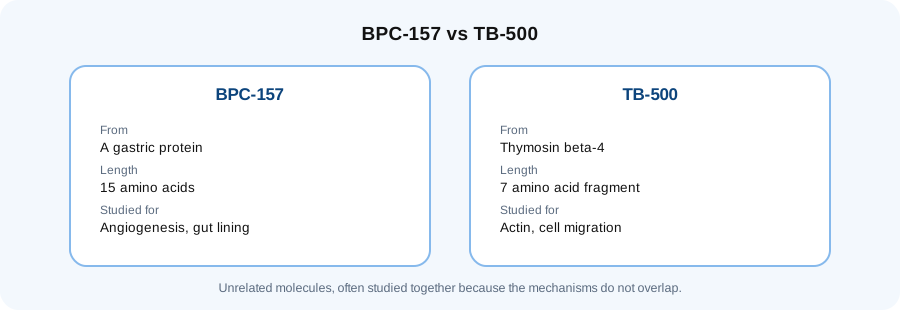
These two get paired constantly, and they are unrelated molecules. BPC-157 comes from a gastric protein and is studied for angiogenesis and gut signalling. TB-500 is a fragment of thymosin beta-4 and is studied for actin regulation and cell migration.
The lack of overlap is exactly why they are researched together: two different mechanisms rather than two versions of one. PhaseOne supplies them separately and as a combined blend .
BPC-157 in blends
BPC-157 is the base of every blend in the range.
| Blend | Components | Vial |
|---|---|---|
| BPC-157 + TB-500 | BPC-157, TB-500 | 10mg or 20mg |
| GLOW | BPC-157, TB-500, GHK-Cu | 70mg |
| KLOW | BPC-157, TB-500, GHK-Cu, KPV | 80mg |
See the two-peptide blend guide , the GLOW guide and the KLOW guide , or shop GLOW and KLOW .
Reconstitution volumes
BPC-157 arrives as a lyophilised powder in 5mg and 10mg vials. The water you add sets the concentration.
| Vial | Bac water added | Concentration | 250mcg draw |
|---|---|---|---|
| 5mg | 2ml | 2.5mg per ml | 0.1ml, 10 units |
| 5mg | 1ml | 5mg per ml | 0.05ml, 5 units |
| 10mg | 2ml | 5mg per ml | 0.05ml, 5 units |
| 10mg | 3ml | 3.3mg per ml | 0.075ml, 7.5 units |
Use the peptide dosage calculator for other volumes and the reconstitution guide for technique. You will need bacteriostatic water and 1ml syringes, both in the Starter Kit . Refrigerate once mixed, per the storage guide .
Naming and how it gets written
BPC-157, BPC 157, BPC157 and plain BPC all refer to the same compound, and research literature also calls it pentadecapeptide BPC 157 or PL 14736. It is frequently mistyped as BCP157, BCP 157, BP157 or BOC157, which is worth knowing when comparing supplier listings.
Common misconceptions
The first is that BPC-157 is a recovery compound with established human evidence. It is a research peptide with a substantial animal literature and a thin human one. The second is treating it as interchangeable with TB-500 because they are sold together. The third is assuming the gastric origin limits it to gut research, when the angiogenesis work is the broader thread. The fourth is expecting capsules or creams to behave like the reconstituted powder used in studies, when the research was not done on those formats.
Checking purity before you order
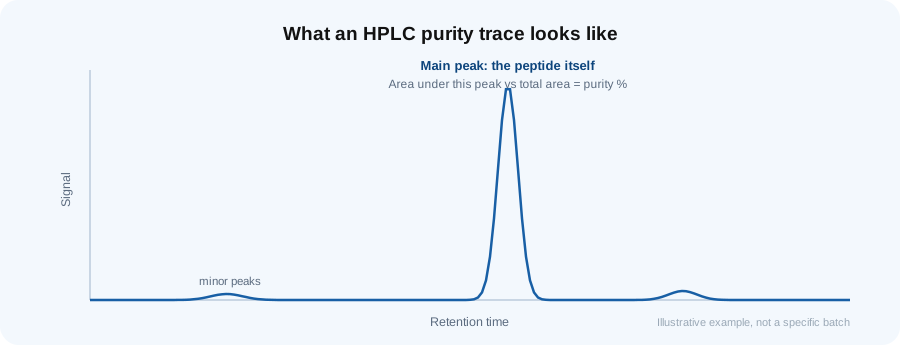
Every PhaseOne BPC-157 batch is independently HPLC tested at 99% or higher, and the Certificate of Analysis for that batch is published in our public COA library so you can read it before ordering rather than after the vial arrives.
For how to read a certificate, see the HPLC testing guide , and for what to expect from any supplier, the research standards guide .
Buying BPC-157 in Australia
BPC-157 is not registered on the ARTG and is not stocked by pharmacies. It is supplied here as a research compound, in 5mg and 10mg vials, dispatched from Sydney with tracking. View BPC-157 pricing , or browse the full research peptide range .
Related research guides
For the compound it is most often paired with, see the TB-500 guide . For the blends, see GLOW and KLOW . For the category, see the regenerative peptide guide . For handling, see the reconstitution guide .
Frequently Asked Questions
What is BPC-157?
A synthetic fifteen amino acid peptide derived from a protein found in gastric juice. BPC stands for body protection compound. It is supplied for laboratory research only.
What is bpc157 short for?
Body protection compound 157. It is also written BPC-157, BPC 157 and plain BPC, and called pentadecapeptide BPC 157 or PL 14736 in research literature.
Where does BPC-157 come from?
It is a synthetic fragment of a protective protein identified in human gastric juice, which is why the early research focused on the stomach and intestinal lining.
What is BPC-157 studied for?
Four pathways: angiogenesis and VEGF signalling, gastric and gut-lining signalling, growth factor modulation, and nitric oxide system interaction.
Is most BPC-157 research done in humans?
No. The literature is overwhelmingly animal-model and in-vitro. Human clinical trials are few and small, which is the main limitation on what can be claimed.
Is BPC-157 the same as TB-500?
No. They are unrelated molecules with different origins and mechanisms. They are often studied together precisely because the mechanisms do not overlap.
Which blends contain BPC-157?
All three: the BPC-157 and TB-500 blend, GLOW with GHK-Cu added, and KLOW with GHK-Cu and KPV.
How is BPC-157 reconstituted?
With bacteriostatic water added slowly down the vial wall, swirled rather than shaken, then refrigerated. A 10mg vial with 2ml gives 5mg per ml.
How much bacteriostatic water do I add to BPC-157?
Commonly 1ml to 3ml depending on the vial and the concentration you want. The dosage calculator works out any combination.
Does BPC-157 come in capsules or creams?
Not from PhaseOne. We supply lyophilised powder in sealed vials. Capsule and cream formats are different preparations, and the research literature is not based on them.
Is BPC-157 legal in Australia?
It is not registered on the ARTG and is not an approved medicine, so pharmacies do not stock it. It is supplied by research suppliers as a laboratory research compound.
How is BPC-157 purity verified?
Every batch is independently HPLC tested at 99% or higher, with the Certificate of Analysis published in our public COA library.
What vial sizes does PhaseOne supply?
5mg and 10mg, shipped Australia-wide from Sydney with batch results published in the COA library.
How should BPC-157 be stored?
Sealed vials refrigerated and out of light. Once reconstituted, refrigerate and use within the timeframe in the storage guide. Do not freeze a reconstituted solution.
Disclaimer
All products supplied by PhaseOne are intended strictly for laboratory research purposes only. Products are not intended for human consumption, therapeutic use, cosmetic use, veterinary use, or diagnostic applications.


