
BPC-157 and TB-500 Blend Explained (Wolverine Stack) Australia

| Components | BPC-157 and TB-500 |
|---|---|
| Also known as | Wolverine stack, bpc157 tb500, bpc-157 tb-500 |
| BPC-157 contributes | Angiogenesis and gut-lining signalling |
| TB-500 contributes | Actin binding and cell migration |
| Vial sizes supplied | 10mg and 20mg |
| Compared with | GLOW (adds GHK-Cu), KLOW (adds GHK-Cu and KPV) |
| Purity | 99% or higher, independently HPLC tested per batch |
The BPC-157 and TB-500 blend puts two peptides in one vial: BPC-157, studied for angiogenesis and gut-lining signalling, and TB-500, studied for actin regulation and cell migration. Informally it gets called the wolverine stack.
This guide covers why the two are paired, what each contributes, how the blend compares with GLOW and KLOW, reconstitution volumes, and how to check a batch. The blend is supplied by PhaseOne in 10mg and 20mg vials, strictly for laboratory research.
On this page
Why these two | What each contributes | Blend or separate vials | vs GLOW and KLOW | Reconstitution | Checking purity | FAQs
Key points at a glance
- Two peptides in one vial: BPC-157 and TB-500
- Written bpc157 tb500, bpc 157 and tb 500, bpc-157 tb-500, and nicknamed the wolverine stack
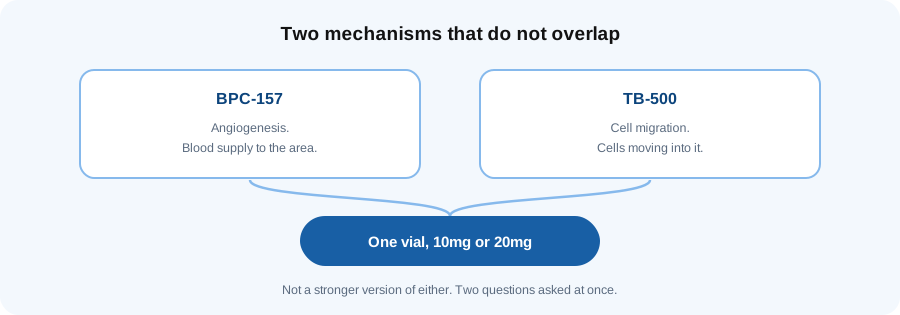
- The two mechanisms are unrelated, so the blend covers two questions rather than intensifying one
- The simplest of the three PhaseOne blends. GLOW adds GHK-Cu, KLOW adds GHK-Cu and KPV
- Supplied in 10mg and 20mg vials for laboratory research only
Why these two are paired
Because they do different jobs. BPC-157 is studied for angiogenesis, the formation of new blood vessels, and for signalling in the gut lining it came from. TB-500 is studied for actin binding and cell migration, the machinery cells use to move.
Blood supply and cell movement are two halves of the same picture in tissue research, which is why the pair shows up together so consistently. It is not that one boosts the other; they simply answer different questions in the same experiment.
What each one contributes
| Peptide | From | Studied for |
|---|---|---|
| BPC-157 | A protein in gastric juice | Angiogenesis, gut-lining signalling |
| TB-500 | A fragment of thymosin beta-4 | Actin binding, cell migration |
Full profiles are in the BPC-157 guide and the TB-500 guide . Both are also sold individually: BPC-157 and TB-500 .
Blend or separate vials?
A genuine trade-off rather than a sales pitch, so here is both sides.
| Blend | Separate vials | |
|---|---|---|
| Ratio | Fixed | Set by you |
| Reconstitution | One vial, one calculation | Two of each |
| Consistency across replicates | Higher | Depends on your technique |
| Cost | Lower than two vials | Higher |
| Suits | A set ratio, repeated preparations | Varying one component independently |
If the design needs to change how much of one peptide is present without touching the other, buy them separately. If the ratio is fixed and the work is repetitive, the blend removes a step and a source of error each time.
How it compares with GLOW and KLOW
This blend is the base. The others build on it.
| BPC-157 + TB-500 | GLOW | KLOW | |
|---|---|---|---|
| Peptides | 2 | 3 | 4 |
| Adds | Baseline pairing | GHK-Cu | GHK-Cu and KPV |
| Vial | 10mg or 20mg | 70mg | 80mg |
| Pathways covered | Vascular, cell migration | Plus copper-dependent remodelling | Plus inflammation |
See the GLOW guide and KLOW guide , or shop GLOW and KLOW .
What the research does not establish
Each compound has its own pre-clinical literature. Research on the two in combination is thin, which means the case for pairing them rests on the mechanisms being complementary rather than on studies of the blend itself.
That is a reasonable basis for a research design and a poor basis for an outcome claim. Treat any supplier promising specific results from the combination as selling ahead of the evidence.
Reconstitution volumes
The vial holds the combined milligrams across both peptides, so the concentration below is the total and each component sits at its own share of it.
| Vial | Bac water added | Total concentration | Volume per 1mg total |
|---|---|---|---|
| 10mg | 2ml | 5mg per ml | 0.2ml, 20 units |
| 20mg | 3ml | 6.7mg per ml | 0.15ml, 15 units |
| 20mg | 4ml | 5mg per ml | 0.2ml, 20 units |
Use the peptide dosage calculator to work each peptide out separately, and the reconstitution guide for technique. You will need bacteriostatic water and 1ml syringes, both in the Starter Kit . Refrigerate once mixed, per the storage guide .
The wolverine stack name
The nickname comes from the comic book character who heals quickly, not from any research literature. It is worth knowing because it is how the pairing gets searched and discussed, but it says nothing about what the compounds do. Searches for wolverine stack australia, bpc157 tb500 and bpc 157 and tb 500 all describe this blend.
Common misconceptions
The first is that the blend is stronger than either peptide alone. It is not: it covers two mechanisms rather than deepening one. The second is that the two compounds are related, when one comes from a gastric protein and the other from thymosin beta-4. The third is that a blend certificate can report one combined purity figure, when it should identify each component separately.
Checking purity before you order
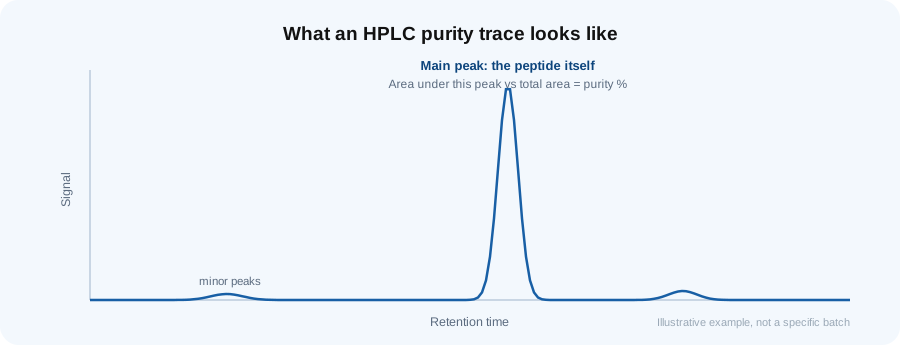
For a blend, the certificate should confirm both components rather than give a single combined number. Every PhaseOne batch is independently HPLC tested at 99% or higher, and the Certificate of Analysis is published in our public COA library so you can read it before ordering.
See the HPLC testing guide for how to read one and the research standards guide for what to expect from any supplier.
Buying the blend in Australia
PhaseOne supplies the BPC-157 and TB-500 blend in 10mg and 20mg vials, dispatched from Sydney with tracking. View blend pricing , or compare GLOW and KLOW . Neither compound is ARTG registered, and both are supplied as research compounds only.
Related research guides
For the components, see the BPC-157 guide and TB-500 guide . For the larger blends, see GLOW and KLOW . For the category, see the regenerative peptide guide .
Frequently Asked Questions
What is the BPC-157 and TB-500 blend?
Two research peptides in one vial: BPC-157, studied for angiogenesis and gut-lining signalling, and TB-500, studied for actin binding and cell migration. Supplied in 10mg and 20mg vials for laboratory research.
What is the wolverine stack?
An informal nickname for the BPC-157 and TB-500 pairing, taken from the comic book character rather than from research. It describes this blend.
Why are BPC-157 and TB-500 combined?
Because their mechanisms do not overlap. One is studied for blood vessel formation, the other for cell movement, so pairing them covers two questions in one preparation.
Is the blend stronger than either peptide alone?
No. It covers two mechanisms rather than intensifying one. Anyone describing it as stronger is misreading what a blend does.
Should I buy the blend or separate vials?
The blend if the ratio is fixed and you prepare repeatedly, since it removes a step and a source of error. Separate vials if the design needs one component varied independently.
How does this blend differ from GLOW and KLOW?
GLOW adds GHK-Cu to these two. KLOW adds GHK-Cu and KPV. This blend is the simplest of the three.
How is the blend reconstituted?
With bacteriostatic water added down the vial wall, swirled rather than shaken, then refrigerated. A 20mg vial with 4ml gives 5mg per ml in total.
How much bacteriostatic water do I add?
Commonly 2ml to 4ml depending on the vial and the concentration you want. The blends tab of the dosage calculator splits it across both peptides.
Is there research on the combination itself?
Little. Each compound has its own pre-clinical literature, but combination-specific work is thin, so the pairing rests on complementary mechanisms rather than blend studies.
How is the blend's purity verified?
Every batch is independently HPLC tested, with a Certificate of Analysis identifying both components rather than one combined figure. Results are published in our public COA library.
What vial sizes are available?
10mg and 20mg, shipped Australia-wide from Sydney with tracking.
Is the blend legal in Australia?
Neither compound is registered on the ARTG or approved as a medicine, so pharmacies do not stock them. Both are supplied as laboratory research compounds.
Disclaimer
All products supplied by PhaseOne are intended strictly for laboratory research purposes only. Products are not intended for human consumption, therapeutic use, cosmetic use, veterinary use, or diagnostic applications.


