
What Is TB-500? Thymosin Beta-4 Fragment Guide (Australia)

| Also known as | TB 500, TB500, thymosin beta-4 fragment |
|---|---|
| What it is | Synthetic fragment of thymosin beta-4, not the full 43 amino acid protein |
| Studied for | Actin binding, cytoskeletal remodelling, cell migration |
| Research maturity | Predominantly pre-clinical, in-vitro and animal-model |
| Found in blends | BPC-157 + TB-500, GLOW, KLOW |
| Vial size supplied | 10mg lyophilised powder |
| Purity | 99% or higher, independently HPLC tested per batch |
TB-500 vs BPC-157
| TB-500 | BPC-157 | |
|---|---|---|
| Origin | Fragment of thymosin beta-4 | Fragment of a gastric-juice-derived protective protein |
| Primary mechanism | Actin-binding, cell migration regulation | Angiogenesis (VEGF pathway), gastric/gut-lining signalling |
| Secondary mechanism | Wound-margin cell mobility, cytoskeletal remodelling | Growth factor modulation (EGF, FGF), nitric oxide system interaction |
| Research origin | First studied in wound-healing and cardiac tissue models | First studied in gastric mucosal models (early 1990s) |
| Commonly combined with | BPC-157, GHK-Cu (see GLOW / KLOW) | TB-500, GHK-Cu (see GLOW / KLOW) |
TB-500 is a synthetic fragment of thymosin beta-4, a naturally occurring protein involved in cell movement and tissue repair. The fragment is the part that binds actin, the protein cells use to build their internal skeleton, which is what the research is about.
This guide covers what TB-500 is, why it is a fragment rather than the whole protein, what actin regulation actually means, how it differs from BPC-157, reconstitution volumes, and how to check a batch. TB-500 is supplied by PhaseOne in 10mg vials, strictly for laboratory research.
On this page
What is TB-500 | Fragment vs protein | Actin regulation | What the research does not show | vs BPC-157 | Reconstitution | Checking purity | FAQs
Key points at a glance
- A synthetic fragment of thymosin beta-4, not the full 43 amino acid protein
- Written TB-500, TB 500, TB500 and sometimes TB4 after the parent protein
- Studied for actin binding, cytoskeletal remodelling and cell migration
- The research base is predominantly animal-model and in-vitro
- Mechanistically unrelated to BPC-157, which is why the two are studied together
- Supplied in 10mg vials for laboratory research only
What is TB-500?
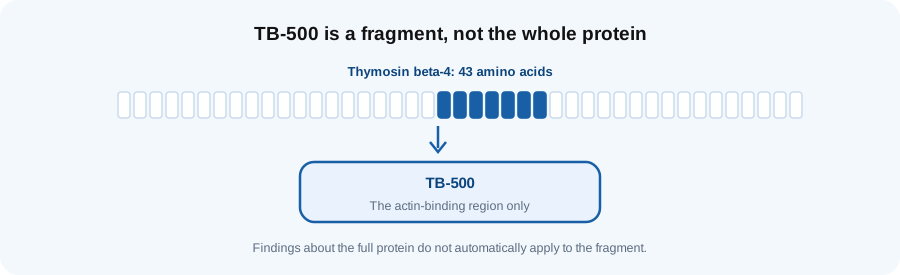
Thymosin beta-4 is a 43 amino acid protein found across many tissue types, involved in cell movement and repair. TB-500 is a shorter synthetic sequence taken from the part of that protein responsible for binding actin.
So TB-500 is not thymosin beta-4 with a different name. It is the working section of it, made synthetically because the fragment is cheaper to produce, more stable and easier to study than the full protein.
A fragment, not the whole protein
This distinction is the single most common error in TB-500 listings, and it changes how the literature should be read. Studies on full-length thymosin beta-4 are not automatically studies on TB-500, and a supplier who blurs the two is either careless or counting on you not noticing.
When comparing listings, the useful question is which one the certificate identifies. Every PhaseOne batch is tested for the fragment specifically.
What actin regulation means
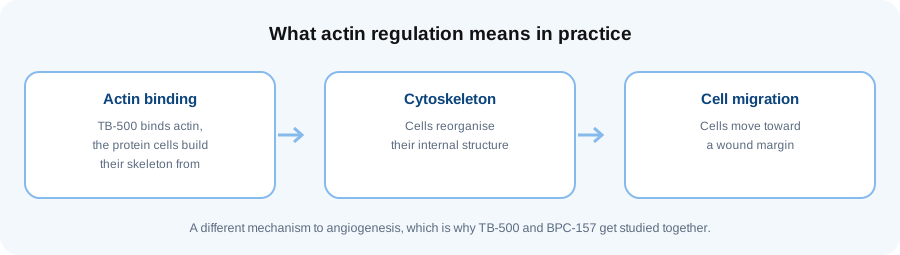
Actin is the protein cells build their internal scaffolding from. Rearranging that scaffolding is how a cell changes shape and moves, which is what a cell has to do to migrate toward a wound margin.
TB-500 binds actin and is studied for its influence on that reorganisation. That is the whole mechanism in plain terms: not growth, not repair as such, but the machinery cells use to move.
What the research does not establish
The TB-500 literature is predominantly pre-clinical: cell culture and animal-model work. Human clinical research is limited, and smaller than the equivalent body of work on BPC-157.
Two specific cautions. First, findings on the parent protein get quoted as if they were findings on the fragment, and they are not the same material. Second, cell migration in a culture dish is a long way from an outcome in a person. Both gaps are routinely glossed over in marketing copy, including by suppliers who should know better.
TB-500 vs BPC-157
Different molecules, different origins, different mechanisms.
| TB-500 | BPC-157 | |
|---|---|---|
| From | Thymosin beta-4 | A gastric protein |
| Studied for | Actin binding, cell migration | Angiogenesis, gut-lining signalling |
| Research base | Predominantly pre-clinical | Large animal-model, limited human |
| Vial sizes | 10mg | 5mg and 10mg |
They are paired constantly precisely because the mechanisms do not overlap. See the BPC-157 guide or the BPC-157 and TB-500 blend , which puts both in one vial.
TB-500 in blends
TB-500 appears in all three PhaseOne blends.
| Blend | Components | Vial |
|---|---|---|
| BPC-157 + TB-500 | BPC-157, TB-500 | 10mg or 20mg |
| GLOW | BPC-157, TB-500, GHK-Cu | 70mg |
| KLOW | BPC-157, TB-500, GHK-Cu, KPV | 80mg |
See the two-peptide blend guide , GLOW and KLOW .
Reconstitution volumes
TB-500 is supplied as a lyophilised powder in 10mg vials. The water you add sets the concentration.
| Vial | Bac water added | Concentration | 250mcg draw |
|---|---|---|---|
| 10mg | 1ml | 10mg per ml | 0.025ml, 2.5 units |
| 10mg | 2ml | 5mg per ml | 0.05ml, 5 units |
| 10mg | 3ml | 3.3mg per ml | 0.075ml, 7.5 units |
| 10mg | 5ml | 2mg per ml | 0.125ml, 12.5 units |
Use the peptide dosage calculator for other volumes and the reconstitution guide for technique. You will need bacteriostatic water and 1ml syringes, both in the Starter Kit . Refrigerate once mixed, per the storage guide .
Naming and how it gets written
TB-500, TB 500 and TB500 are the same compound. You will also see TB4 or Tb4 used loosely, which properly refers to the parent protein thymosin beta-4 rather than the fragment. Listings that use the two names interchangeably are worth a second look.
Common misconceptions
The first is that TB-500 is thymosin beta-4. It is a fragment of it. The second is that it is a version of BPC-157 or interchangeable with it, when the mechanisms are unrelated. The third is that it is a steroid, which it is not: it is a peptide, a short chain of amino acids, with no structural relationship to steroid compounds. The fourth is reading cell culture findings as human outcomes.
Checking purity before you order
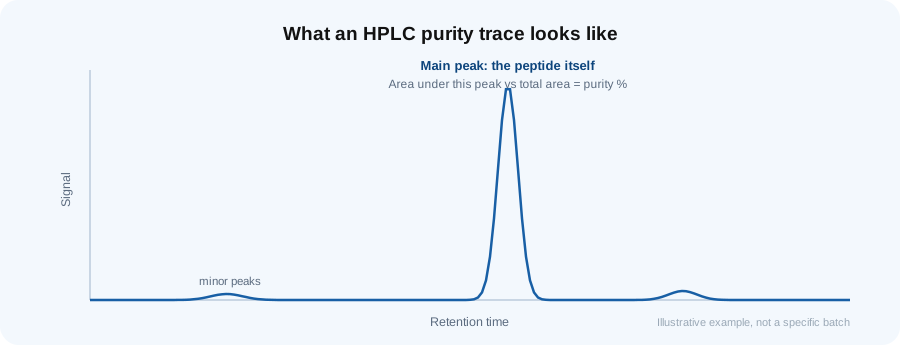
For TB-500 specifically, the certificate should confirm the fragment rather than the parent protein. Every PhaseOne batch is independently HPLC tested at 99% or higher, with the Certificate of Analysis published in our public COA library so you can read it before ordering.
See the HPLC testing guide for how to read a certificate and the research standards guide for what to expect from any supplier.
Buying TB-500 in Australia
TB-500 is not registered on the ARTG and is not stocked by pharmacies. PhaseOne supplies it in 10mg vials, dispatched from Sydney with tracking. View TB-500 pricing , compare the blend with BPC-157 , or browse the full research peptide range .
Related research guides
For the compound it is most often paired with, see the BPC-157 guide . For the blends, see GLOW and KLOW . For the category, see the regenerative peptide guide . For handling, see the reconstitution guide .
Frequently Asked Questions
What is TB-500?
A synthetic fragment of thymosin beta-4, specifically the actin-binding region. It is studied for cell migration and cytoskeletal remodelling, and supplied for laboratory research only.
What is tb500?
The same compound. TB-500, TB 500 and TB500 are all used for the synthetic thymosin beta-4 fragment.
Is TB-500 the same as thymosin beta-4?
No. Thymosin beta-4 is a 43 amino acid protein. TB-500 is a shorter synthetic fragment of it, so findings about the protein do not automatically apply to the fragment.
Where does TB-500 come from?
It is made synthetically, based on the actin-binding section of thymosin beta-4, a protein found naturally across many tissue types.
What is TB-500 studied for?
Actin binding, cytoskeletal remodelling and cell migration. In plain terms, the machinery cells use to change shape and move.
Is TB-500 the same as BPC-157?
No. They are unrelated molecules with different origins and mechanisms, which is why they are often studied together rather than chosen between.
Is TB-500 a steroid?
No. It is a peptide, a short chain of amino acids. Steroids are lipid-based molecules with a four-ring carbon structure and no relationship to it.
Is most TB-500 research done in humans?
No. The literature is predominantly cell culture and animal-model work, and smaller than the equivalent body of research on BPC-157.
Which blends contain TB-500?
All three: the BPC-157 and TB-500 blend, GLOW and KLOW.
How is TB-500 reconstituted?
With bacteriostatic water added slowly down the vial wall, swirled rather than shaken, then refrigerated. A 10mg vial with 2ml gives 5mg per ml.
How much bacteriostatic water do I add to TB-500?
Commonly 1ml to 5ml depending on the concentration you want. More water gives a larger, easier to read draw for the same amount of peptide.
How is TB-500 purity verified?
Every batch is independently HPLC tested at 99% or higher, with the Certificate of Analysis published in our public COA library. For this compound the certificate should confirm the fragment rather than the parent protein.
Is TB-500 legal in Australia?
It is not registered on the ARTG and is not an approved medicine, so pharmacies do not stock it. It is supplied by research suppliers as a laboratory research compound.
How should TB-500 be stored?
Sealed vials refrigerated and out of light. Once reconstituted, refrigerate and do not freeze.
Disclaimer
All products supplied by PhaseOne are intended strictly for laboratory research purposes only. Products are not intended for human consumption, therapeutic use, cosmetic use, veterinary use, or diagnostic applications.


