
Are Peptides Legal in Australia? Research vs Human Use
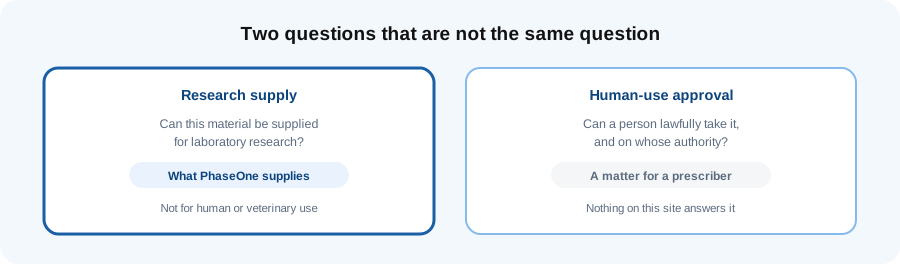
Research supply vs human-use approval
| Research supply | Human-use approval | |
|---|---|---|
| Question answered | May this be supplied as laboratory material? | May a person lawfully take it? |
| Who decides | Supplier, within the law | An authorised prescriber |
| Basis | Laboratory research purpose | Prescription or lawful authority |
| What PhaseOne does | This side only | Not addressed anywhere on this site |
| What a research label settles | What the material is supplied as | Nothing |
Most people searching for whether peptides are legal in Australia are really asking one of two different questions, and the answer depends on which one. Can this material be supplied and held for laboratory research, or is a person allowed to take it? Those are governed by different rules and they have different answers.
This guide sets out which bodies regulate research peptides in Australia, what approved, unapproved and unscheduled each mean, how prescription-only status works, and what any of that means for a researcher placing an order. It is general information about how the system works. It is not legal advice, and it is not a substitute for advice about your own situation.
On this page
Who regulates them | Three different statuses | What Schedule 4 means | Is BPC-157 legal | Is GHK-Cu legal | Which peptides are legal | Importing | Sport and anti-doping | FAQs
Key points at a glance
- Research supply and human-use approval are separate questions. A compound can be lawfully supplied for laboratory research while remaining unlawful for a person to take without a prescription
- The TGA decides whether something is an approved medicine in Australia. The Poisons Standard decides how tightly access to it is controlled
- Schedule 4 means prescription only. A Schedule 4 substance is not something a member of the public can lawfully obtain or hold for personal use without a prescription or other lawful authority
- Several well known research peptides, BPC-157 among them, are Schedule 4 in the current Poisons Standard
- Unscheduled does not mean unregulated. A product making therapeutic claims comes under the TGA regardless of whether the substance is scheduled
- PhaseOne supplies research compounds for laboratory research use only, not for human or veterinary use
- Determining what is lawful for you to buy, hold and use in your own state is your responsibility, and nothing on this site decides it for you
Who regulates peptides in Australia
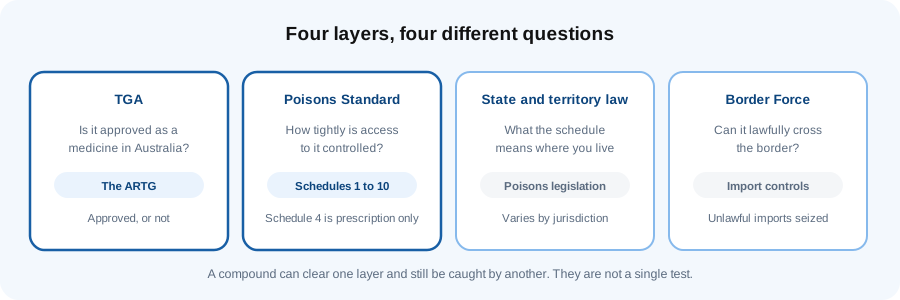
There is no single authority that answers the question, which is the main reason it gets confusing. Four separate layers apply, and a compound can be clear of one and caught by another.
The Therapeutic Goods Administration decides whether a substance is approved as a medicine, and records approved products on the Australian Register of Therapeutic Goods. The Poisons Standard, formally the Standard for the Uniform Scheduling of Medicines and Poisons, sets how tightly access to a substance is controlled by placing it in a schedule. State and territory poisons legislation gives those schedules legal force, and the detail varies between jurisdictions. The Australian Border Force applies import controls at the border, independently of all three.
Approved, unapproved and unscheduled
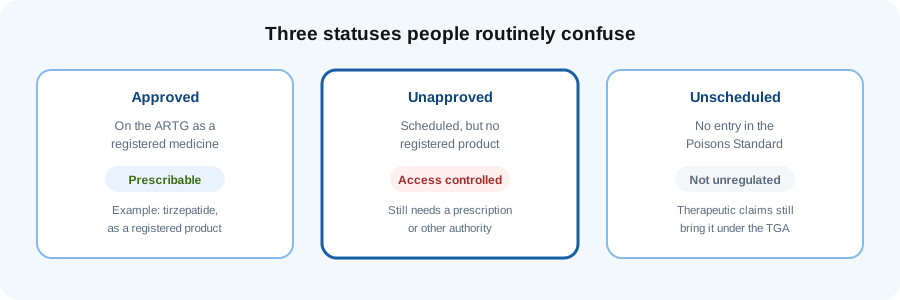
These three terms get used as though they were the same thing. They are not, and the difference is usually where the confusion starts.
| Status | What it means | What follows from it |
|---|---|---|
| Approved | Registered on the ARTG as a medicine | Can be prescribed and dispensed as a registered product |
| Unapproved | No registered product in Australia | Access still controlled by its schedule, and still needs a prescription or authority |
| Unscheduled | No entry in the Poisons Standard | Not freely sellable for human use. Therapeutic claims still bring it under the TGA |
The practical upshot: finding that a peptide has no entry in the Poisons Standard tells you something narrow. It does not establish that it is lawful to sell, hold or take for human use.
What Schedule 4 means
Schedule 4 of the Poisons Standard is the Prescription Only Medicine schedule. A Schedule 4 substance can be supplied for human use only on the prescription or order of an authorised health practitioner.
For a member of the public, that is the whole answer to whether something is available to them. A Schedule 4 substance is not lawfully obtainable or holdable for personal use without a prescription or another lawful authority, whether or not an approved product exists, and whether or not the substance is easy to buy online.
Several compounds commonly discussed as research peptides sit in Schedule 4 in the current Poisons Standard. BPC-157 is one of them, added in 2024 after a scheduling decision. Growth hormone releasing hormones and growth hormone secretagogues are captured as classes, which covers a number of named peptides. Tirzepatide and semaglutide are Schedule 4 as approved prescription medicines.
Is BPC-157 legal in Australia
BPC-157 is a Schedule 4 substance in the current Poisons Standard, which means prescription only. It has no registered product on the ARTG, so it is also an unapproved substance. Taken together: it is not approved as a medicine in Australia, and it is not lawfully available to a member of the public for personal use without a prescription or other lawful authority.
It was unscheduled before 2024. The scheduling decision that changed that was driven partly by the volume of personal importation being referred to the regulator, and the regulator specifically addressed the practice of selling the substance online with research-only labelling, taking the view that such labelling was not preventing consumer misuse. Anyone relying on a research-use label as though it settled the question of personal use should know that the regulator has already considered and rejected that reading.
PhaseOne supplies BPC-157 strictly for laboratory research use. It is not supplied for human or veterinary use, and nothing on this site should be read as advice that any person may take it. Whether you hold the authority required to obtain and possess it lawfully is a question for you and, if relevant, a prescriber.
Is GHK-Cu legal in Australia
GHK-Cu, the copper tripeptide, has no entry in the current Poisons Standard. It is not a scheduled substance, which puts it in a different position from BPC-157 and the growth hormone peptides.
It is also widely used as a cosmetic ingredient, where it appears under the INCI name copper tripeptide-1, and in that context it is regulated as an industrial chemical rather than a medicine. What has not happened is approval as a therapeutic good: there is no registered GHK-Cu medicine on the ARTG, so a product sold with therapeutic claims would come under the TGA regardless of the substance being unscheduled.
PhaseOne supplies GHK-Cu for laboratory research use only. Not being scheduled makes the research supply position simpler. It does not make the compound approved for human use.
Which peptides are legal in Australia
Asked in the abstract, the question has no single answer, because the compounds sold under the heading of research peptides do not share one legal status. Three groups are worth separating.
| Group | Position | Example |
|---|---|---|
| Approved prescription medicines | Registered on the ARTG, Schedule 4, available on prescription | Tirzepatide, semaglutide |
| Scheduled but unapproved | Schedule 4, no registered product, prescription or authority still required | BPC-157, growth hormone secretagogues |
| Unscheduled | No Poisons Standard entry, not approved for therapeutic use either | GHK-Cu and various research-stage compounds |
What none of those groups contains is a peptide that a member of the public may freely buy and use for themselves. That category is effectively empty, which is the part most searches on this topic are hoping to find and will not.
Research supply is not human-use approval
This is the distinction the whole subject turns on. Supplying a compound as laboratory material and approving a compound for a person to take are governed by different rules, assessed by different people, and answered separately.
PhaseOne operates on the first side of that line only. Every compound is supplied for in-vitro and laboratory research use, not for human consumption, injection, topical application, veterinary use, or the diagnosis or treatment of anything. Our product pages describe research context and nothing on them is a therapeutic claim or an implication of regulatory approval.
The second side of the line is not ours to answer and we do not try to. If you are asking whether you personally may take something, that is a question for a qualified prescriber, and the answer may well be no.
Importing peptides into Australia
Importation is its own layer, enforced at the border rather than by the TGA. The Personal Importation Scheme allows an individual to import certain unapproved therapeutic goods for their own use, but on conditions that most online purchases do not meet.
- No more than a three month supply at the maximum dose in any one order, and no more than fifteen months supply across any twelve month period
- For a substance that is prescription only in Australia, a valid Australian prescription or written authority must be held at the time of import
- Controlled substances are not eligible for the scheme at all
- Imported goods cannot be sold, or supplied to anyone outside your immediate family
- An import that does not meet the conditions is unlawful, and may be seized at the border with no compensation
This matters for more than the paperwork. The scheduling decision on BPC-157 followed referrals to the regulator about exactly this kind of importation. Ordering from a domestic supplier avoids the border question entirely, which is one practical reason researchers prefer local stock, but it does not change the substance's schedule or who may lawfully hold it.
Who can lawfully hold a prescription-only substance
Two routes exist, and neither is a purchase decision. A person can hold a Schedule 4 substance in accordance with a prescription from an authorised prescriber. Separately, state and territory poisons legislation provides for authorities and permits held by institutions and individuals for genuine research, analytical and teaching purposes, which is the framework laboratory work sits within.
What does not create an authority is a label, a disclaimer, a checkbox at checkout, or a supplier's description of the material as research grade. Those describe the supply. The authority, if one is needed, has to exist on the holder's side.
Peptides and anti-doping rules
Anyone competing under a sporting code sits under a further set of rules that have nothing to do with the Poisons Standard, and the thresholds are stricter.
BPC-157 is prohibited at all times under the World Anti-Doping Agency's S0 class, covering substances not approved for human therapeutic use by any regulatory authority. Growth hormone secretagogues and growth hormone releasing hormone analogues, which include peptides such as ipamorelin and CJC-1295, fall under the S2 class and are also prohibited at all times. Being unscheduled in Australia does not imply being permitted in sport, and the S0 class in particular is designed to capture compounds precisely because they are unapproved.
Athletes should check the current Prohibited List and Sport Integrity Australia's own resources rather than relying on a vendor page, including ours, since the list is revised annually.
Common misconceptions
That a research-use label resolves the legal question. It describes what the material is supplied as. The regulator has explicitly considered that labelling practice in the context of BPC-157 and did not treat it as sufficient.
That unscheduled means freely legal. It means the substance has no entry in the Poisons Standard. Therapeutic claims, advertising rules and approval requirements all still apply.
That being able to buy something easily says something about its status. Availability and lawfulness are unrelated, and the scheduling decision on BPC-157 is a direct example of the regulator responding to easy availability.
That one answer covers all peptides. The compounds grouped under the term range from registered prescription medicines to substances with no entry anywhere.
What this means if you order from PhaseOne
PhaseOne supplies research compounds for laboratory research purposes only. Products are not intended for human consumption, injection, topical application, veterinary use, or the diagnosis, treatment, cure or prevention of any condition. Nothing on this site advertises an unapproved therapeutic good for human use, makes a therapeutic claim, or implies approval or endorsement by the TGA or any other regulator.
By ordering, you accept that you are responsible for determining whether it is lawful for you to purchase, possess, store, handle and use the material in your own state or territory and for your intended lawful purpose, and for holding any authority that purpose requires. We reserve the right to decline or cancel any order where we have reason to believe the material is intended for human use or any other unlawful purpose.
If what you actually want to know is whether you may take a compound yourself, we are not the right source and neither is any other vendor. Speak to a qualified prescriber.
Related guides
For how purity is verified and documented, see the HPLC standards guide and the research standards guide . For handling the material itself, see the reconstitution guide and the storage guide .
Frequently Asked Questions
Are peptides legal in Australia?
There is no single answer, because the compounds grouped under the term have different statuses. Some are approved prescription medicines, some are prescription only with no approved product, and some have no entry in the Poisons Standard at all. None of them are freely available for a member of the public to use without authority.
Can I legally buy BPC-157 in Australia?
BPC-157 is a Schedule 4 substance in the current Poisons Standard, meaning prescription only, and it has no registered product on the ARTG. It is not approved as a medicine in Australia and is not lawfully available to the public for personal use without a prescription or other lawful authority.
When did BPC-157 become scheduled in Australia?
It was added to Schedule 4 in 2024. Before that it was unscheduled, which is why older discussion of its status is frequently out of date.
Why was BPC-157 scheduled?
The scheduling decision cited a limited evidence base for the claimed benefits alongside a high risk of misuse, and the volume of personal importation being referred to the regulator. The regulator also addressed online vendors labelling the substance for research only, taking the view that this did not prevent consumer misuse.
What is the regulatory status of GHK-Cu?
GHK-Cu has no entry in the current Poisons Standard, so it is not a scheduled substance. It is commonly used as a cosmetic ingredient under the name copper tripeptide-1. It is not an approved therapeutic good, so a product making therapeutic claims about it would still come under the TGA.
What does Schedule 4 mean?
Schedule 4 is the Prescription Only Medicine schedule of the Poisons Standard. A Schedule 4 substance may be supplied for human use only on the prescription or order of an authorised health practitioner.
Does unscheduled mean legal?
No. It means the substance has no entry in the Poisons Standard. Approval requirements, advertising rules and therapeutic claim restrictions still apply, and an unscheduled substance is not thereby approved for human use.
What is the difference between unapproved and unscheduled?
Unapproved means there is no registered product on the ARTG. Unscheduled means there is no entry in the Poisons Standard. A substance can be unapproved and still prescription only, which is the position BPC-157 is in.
What is the ARTG?
The Australian Register of Therapeutic Goods, the TGA's register of medicines and medical devices approved for supply in Australia. A substance with no ARTG entry is an unapproved therapeutic good.
What is the Poisons Standard?
The Standard for the Uniform Scheduling of Medicines and Poisons, which places substances into schedules according to how tightly access should be controlled. State and territory legislation gives those schedules legal force.
Does the law differ between states?
The Poisons Standard is applied through state and territory poisons legislation, and the detail of offences, authorities and permits varies between jurisdictions. The schedule is national; what follows from it is not uniform.
Can I legally import peptides into Australia?
The Personal Importation Scheme permits certain unapproved goods for personal use, but only within quantity limits, only with a valid Australian prescription where the substance is prescription only, and not at all for controlled substances. Imports outside those conditions are unlawful and may be seized.
How much can be imported under the personal importation scheme?
No more than a three month supply at the maximum dose per order, and no more than fifteen months supply in any twelve month period. The goods cannot be sold or supplied outside your immediate family.
Does buying from an Australian supplier change the legal status?
No. Domestic supply removes the border and import question, but it does not alter a substance's schedule or who may lawfully hold it.
Does a research-use-only label make a purchase lawful?
No. The label describes what the material is supplied as. In the BPC-157 scheduling decision the regulator considered that labelling practice directly and did not accept it as preventing misuse.
Who can lawfully possess a Schedule 4 substance?
A person holding it in accordance with a prescription from an authorised prescriber, or a person or institution holding an authority or permit for genuine research, analytical or teaching purposes under their state or territory's poisons legislation.
Are research peptides banned in sport?
Many are prohibited at all times. BPC-157 falls under the World Anti-Doping Agency's S0 class for non-approved substances, and growth hormone secretagogues and GHRH analogues fall under S2. Athletes should check the current Prohibited List and Sport Integrity Australia directly.
Does PhaseOne supply peptides for human use?
No. Every compound is supplied for in-vitro and laboratory research purposes only, and not for human consumption, injection, topical application or veterinary use.
Who is responsible for determining what is lawful for me?
You are. By ordering you accept responsibility for determining whether it is lawful for you to purchase, possess, store, handle and use the material in your jurisdiction and for your intended lawful purpose, and for holding any authority that requires.
Is this page legal advice?
No. It is general information about how Australian regulation of these compounds is structured. It is not legal or medical advice and should not be relied on as a substitute for advice about your own circumstances.
Disclaimer
This page is general information about the regulatory framework and is not legal or medical advice. Regulation changes, and the Poisons Standard is amended periodically. Check the current Poisons Standard and TGA guidance, or obtain your own advice, rather than relying on this page.
All products supplied by PhaseOne are intended strictly for laboratory research purposes only. Products are not intended for human consumption, therapeutic use, cosmetic use, veterinary use, or diagnostic applications.