
What Is Tesamorelin? Tesamorelin Peptide Research Guide

| Sequence length | 44 amino acids, the full native GHRH length |
|---|---|
| Relationship to native GHRH | Full length, not a fragment |
| Stabilising modification | Trans-3-hexenoic acid at the N-terminus |
| Receptor target | GHRH receptor, the same receptor as CJC-1295 |
| Alternative names | None in common use; Tesamorelin is the INN |
| Clinical literature | Genuine human clinical base, unusual in this category, but tied to one narrow indication |
| Vial size | 10mg lyophilised powder |
| Purity | Greater than or equal to 99% by HPLC, batch certificate published publicly |
| Australian status | Not ARTG registered; supplied for laboratory research only |
Tesamorelin vs CJC-1295 No DAC
| Tesamorelin | CJC-1295 No DAC | |
|---|---|---|
| Length | 44 amino acids | 29 amino acids |
| Relationship to native GHRH | Full length | Working fragment |
| Stabilising modification | Trans-3-hexenoic acid at the N-terminus | Four amino acid substitutions |
| Receptor | GHRH receptor | GHRH receptor |
| Clinical literature | Genuine human clinical base | Largely pre-clinical |
| Typical research use | Reference against the natural signal | Combination work with Ipamorelin |
| Also called | Nothing in common use | Mod GRF 1-29 |
Tesamorelin is a 44 amino acid analogue of growth hormone releasing hormone, stabilised with a modification at one end so enzymes cannot dismantle it the way they destroy native GHRH within minutes. Of every GHRH compound in this catalogue it is the closest structural match to the hormone it is modelled on, because it keeps the full length rather than a working fragment.
It matters for one more reason that sets it apart from almost everything else on this site: it has a genuine human clinical research base, not just animal-model work. This guide covers what it is, why the full length matters, how it compares with CJC-1295 and Ipamorelin, why its literature is deeper than its peers, reconstitution volumes for a 10mg vial, and how to check a batch. Tesamorelin is supplied by PhaseOne in 10mg vials, strictly for laboratory research.
On this page
What is Tesamorelin | Why full length matters | How it works | vs CJC-1295 | vs Ipamorelin | Why the literature is deeper | Reconstitution | Checking purity | FAQs
Key points at a glance
- A 44 amino acid GHRH analogue, the full-length sequence rather than a fragment
- Stabilised by a trans-3-hexenoic acid group at the N-terminus
- Acts at the GHRH receptor, the same receptor as CJC-1295
- A different receptor from Ipamorelin, which uses the ghrelin receptor
- The closest structural match to native GHRH in the PhaseOne range
- Has a real human clinical literature, unusual for a compound in this catalogue
- Much of that literature concerns one specific population, which limits how far it generalises
- Not registered on the ARTG, supplied for laboratory research only
- Supplied in 10mg vials, at least 99% HPLC purity, certificate published publicly
What is Tesamorelin?
Growth hormone releasing hormone is the signal the hypothalamus sends to the pituitary. Native GHRH is 44 amino acids long and is cut apart by the enzyme DPP-4 within a couple of minutes, which makes it useless as a research tool in its natural form.
Tesamorelin solves that without shortening the molecule. It keeps all 44 amino acids and adds a trans-3-hexenoic acid group at the N-terminus, which is where the enzyme would otherwise attack. The result is the natural sequence, made durable.
| Property | Tesamorelin |
|---|---|
| Sequence length | 44 amino acids |
| Relationship to native GHRH | Full length, not a fragment |
| Stabilising modification | Trans-3-hexenoic acid at the N-terminus |
| Receptor target | GHRH receptor |
| Alternative names | None in common use; Tesamorelin is the INN |
| Vial size supplied | 10mg lyophilised powder |
| Purity standard | Greater than or equal to 99% by HPLC |
| Australian status | Not ARTG registered; laboratory research only |
Unlike most compounds in this range, Tesamorelin has no cloud of alternative names to sort through. There is no equivalent of Mod GRF 1-29 or Ipa here, which makes comparing listings simpler than usual.
Why the full length matters
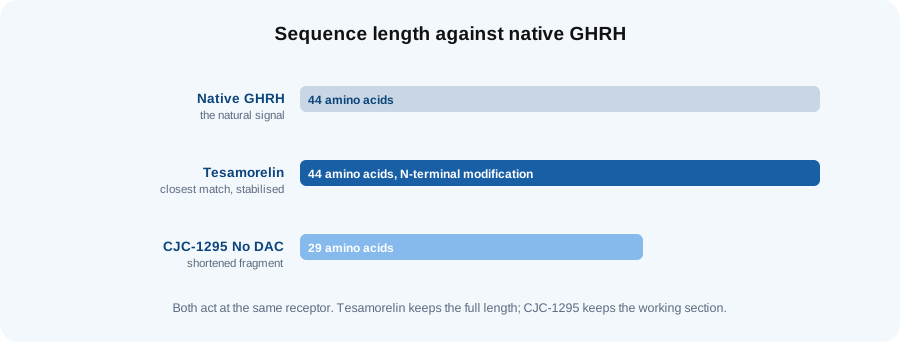
The GHRH family splits into two approaches. Keep the whole hormone and protect it, or keep only the part that binds the receptor and protect that. Tesamorelin took the first route, CJC-1295 the second.
Neither is better in the abstract. The fragment is cheaper to make and shorter-acting, which suits combination work. The full-length molecule is the better comparator when the research question is about how the natural signal behaves, because there is less structural difference to argue about.
How it works
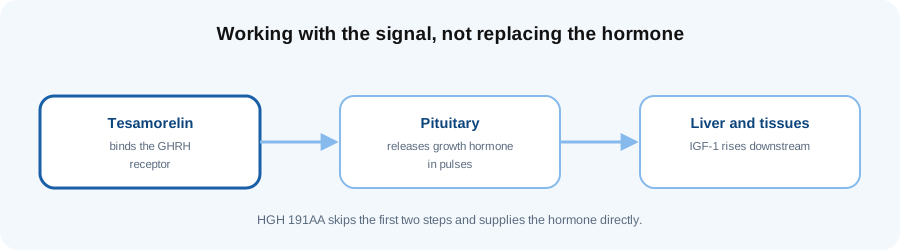
Tesamorelin binds the GHRH receptor on the anterior pituitary and amplifies a signal the body already sends. The pituitary then releases growth hormone on its own rhythm, and IGF-1 rises downstream of that as a secondary marker.
The useful distinction is between working on the signal and supplying the hormone. Tesamorelin does the former. HGH 191AA does the latter, skipping the receptor and the pituitary entirely. That is why the two are not substitutes even though both end up at growth hormone.
Because release stays pulsatile, measurement timing relative to dosing matters here as much as it does for Ipamorelin . A sample drawn between pulses reads very differently from one drawn at a peak.
Tesamorelin vs CJC-1295
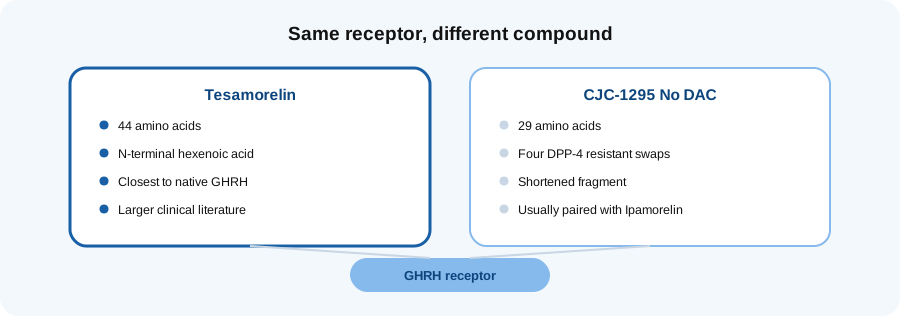
This is the comparison that actually matters, because the two compounds do the same job at the same receptor and the differences are real but easy to overstate.
| Tesamorelin | CJC-1295 No DAC | |
|---|---|---|
| Length | 44 amino acids | 29 amino acids |
| Relationship to native GHRH | Full length | Working fragment |
| Stabilising modification | Trans-3-hexenoic acid at the N-terminus | Four amino acid substitutions |
| Receptor | GHRH receptor | GHRH receptor |
| Half-life | Hours | Hours |
| Clinical literature | Genuine human clinical base | Largely pre-clinical |
| Typical research use | Reference against the natural signal | Combination work with Ipamorelin |
| Also called | Nothing in common use | Mod GRF 1-29 |
Treating them as interchangeable because they share a receptor is the common error. Treating them as wildly different is the opposite error. The practical split is that Tesamorelin is the better reference compound and CJC-1295 is the one that slots into a combination protocol. See the CJC-1295 guide for that compound on its own.
Tesamorelin vs Ipamorelin
Not a comparison so much as a category distinction. Tesamorelin works at the GHRH receptor, Ipamorelin at the ghrelin receptor. Two separate doors into the same room.
| Tesamorelin | Ipamorelin | |
|---|---|---|
| Receptor | GHRH receptor | GHS-R, the ghrelin receptor |
| Class | Full-length GHRH analogue | Selective secretagogue |
| Length | 44 amino acids | 5 amino acids |
| Signal | Amplifies the releasing signal | Prompts release |
| Redundant with each other | No | No |
Because the receptors are independent, a GHRH analogue and a secretagogue can be studied together rather than chosen between. That pairing is usually built with CJC-1295 rather than Tesamorelin, mostly for cost and because the shorter fragment is easier to time, and it is covered in the CJC-1295 and Ipamorelin guide .
Why the literature is deeper than its peers
Most compounds in this catalogue rest on animal-model and cell-culture work. Tesamorelin is the exception, and it is worth being precise about why rather than just claiming a stronger evidence base.
Tesamorelin was developed as a pharmaceutical and approved in the United States under the brand name Egrifta for one narrow indication: excess visceral abdominal fat in people with HIV-associated lipodystrophy. Getting there required the full trial programme, which is where the human data comes from. That is also why the visceral adipose tissue thread dominates its literature while other GH-axis compounds have nothing comparable.
Two caveats follow directly from that, and they are the reason this section exists rather than a line boasting about clinical data. The trials studied one specific population with one specific condition, so the findings do not transfer cleanly to any other research question. And an approval in another country is not an approval here: Tesamorelin is not registered on the ARTG, no Australian pharmacy stocks it, and PhaseOne supplies it as a research compound only.
What the research does not establish
The deeper literature cuts both ways, because it gives people more material to over-read.
- The clinical findings belong to one population and one indication. Quoting them as general conclusions about GH-axis stimulation is not supportable.
- A deeper literature than its peers is a low bar in this category, not a high one. It does not make Tesamorelin well characterised for arbitrary research questions.
- Head to head comparisons against CJC-1295 are thin, so the claim that full length behaves better than a fragment is reasoning from structure rather than from measured results.
Pulsatile release makes cross-study comparison harder again, because two studies with identical conditions and different sampling times can disagree.
Reconstituting a 10mg Tesamorelin vial
Tesamorelin arrives as a lyophilised powder and is reconstituted with bacteriostatic water . Quantities here are in milligrams rather than micrograms, so the draws are larger and easier to measure than for a secretagogue. Units are on a 100 unit U-100 syringe.
| Bacteriostatic water added | Concentration | 1mg draw | 2mg draw |
|---|---|---|---|
| 2ml | 5mg/ml | 0.20ml, 20 units | 0.40ml, 40 units |
| 3ml | 3.3mg/ml | 0.30ml, 30 units | 0.60ml, 60 units |
| 4ml | 2.5mg/ml | 0.40ml, 40 units | 0.80ml, 80 units |
| 5ml | 2mg/ml | 0.50ml, 50 units | 1.00ml, 100 units |
At 5ml a 2mg draw fills the whole syringe, so 2ml to 3ml is the more practical range if larger amounts are needed. Work out any combination with the peptide dosage calculator , and see the reconstitution guide for technique.
Add the water slowly down the vial wall, swirl rather than shake, then refrigerate once dissolved and keep it out of light. The storage guide covers the stability variables in full.
Checking purity before you order
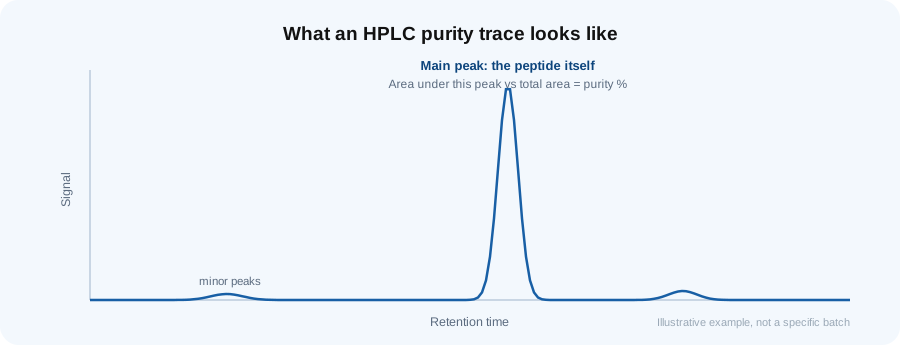
A 44 amino acid chain is harder to synthesise cleanly than a five amino acid one, and the usual failure is not contamination but truncation: sequences that stopped short during synthesis. Those are closely related to the real thing, which makes identity testing matter as much as the purity percentage.
Every PhaseOne batch is independently tested to a standard of at least 99% purity by HPLC, and the certificate for each batch is published in our public COA library . You can read the result before ordering rather than taking a purity claim on trust. No COA is shipped with the vial; it is simply public.
For how to read a chromatogram, see the HPLC testing guide , and for what any supplier should be able to show you, the research standards guide .
Buying Tesamorelin in Australia
PhaseOne supplies Tesamorelin in 10mg vials from Australian stock, shipped Australia-wide, for laboratory research only, with every batch HPLC tested to at least 99% purity and the certificate published publicly.
Three checks against any Australian Tesamorelin supplier. Does the certificate confirm the full 44 amino acid sequence rather than just a purity figure? Is it batch-specific rather than a generic sample? And is the stock held locally or drop-shipped from overseas, which affects transit time and the cold chain.
Tesamorelin sits at the higher end of the range on price, which is a direct consequence of the sequence length. If the research question does not specifically need full-length GHRH, CJC-1295 No DAC covers the same receptor for less. Browse the full research range .
Related research guides
For the other GHRH analogue, the CJC-1295 guide . For the ghrelin receptor side, the Ipamorelin guide and the CJC-1295 and Ipamorelin guide . For the rest of the axis, the HGH 191AA guide and IGF-1 LR3 guide . For the category, the growth hormone peptide guide . For handling, the reconstitution guide and storage guide . For verification, the HPLC testing guide and the COA library .
Frequently Asked Questions
What is Tesamorelin in simple terms?
A synthetic 44 amino acid analogue of growth hormone releasing hormone, stabilised with a trans-3-hexenoic acid group at the N-terminus so the enzyme DPP-4 cannot break it down. It acts at the GHRH receptor.
Is Tesamorelin a peptide?
Yes. It is a 44 amino acid chain, which makes it one of the longer peptides in this catalogue. Length is the main thing separating it from CJC-1295.
Why is Tesamorelin 44 amino acids when CJC-1295 is 29?
Two different design choices. Tesamorelin keeps the whole native GHRH sequence and protects it. CJC-1295 keeps only the section that binds the receptor. Neither is better in the abstract.
What is the difference between Tesamorelin and CJC-1295?
Both act at the GHRH receptor with a half-life in hours. Tesamorelin is full length with a different stabilising modification and a genuine human clinical literature; CJC-1295 is a shorter fragment, cheaper, and the one usually paired with Ipamorelin.
What is the difference between Tesamorelin and Ipamorelin?
Different receptors. Tesamorelin acts at the GHRH receptor, Ipamorelin at the ghrelin receptor. They are not redundant, which is why a GHRH analogue and a secretagogue can be studied together.
How does Tesamorelin differ from HGH?
Tesamorelin signals the pituitary to release growth hormone on its own rhythm. HGH 191AA is growth hormone itself and skips the receptor and the pituitary entirely.
Why does Tesamorelin have more clinical research than other peptides here?
Because it was developed as a pharmaceutical and approved in the United States as Egrifta for one narrow indication, excess visceral abdominal fat in HIV-associated lipodystrophy. That approval required a full trial programme, which is where the human data comes from.
Does that clinical data apply to other research questions?
Not cleanly. The trials studied one specific population with one specific condition. Quoting those findings as general conclusions about GH-axis stimulation is not supportable.
Is Tesamorelin approved in Australia?
No. It is not registered on the ARTG and is not approved for supply as a medicine here, so no pharmacy or chemist stocks it. An approval in another country is not an approval in Australia.
Is Tesamorelin the same as Egrifta?
Egrifta is the brand name under which Tesamorelin was approved overseas. The compound is the same molecule, but what PhaseOne supplies is a research-grade vial, not a pharmaceutical product, and it is not for human use.
Does Tesamorelin have other names?
No. Tesamorelin is the international nonproprietary name and there is no widely used alternative, unlike CJC-1295 which is also called Mod GRF 1-29.
What vial size does Tesamorelin come in?
10mg of lyophilised powder.
How much bacteriostatic water should a 10mg Tesamorelin vial be reconstituted with?
2ml to 3ml is practical, giving 5mg/ml or 3.3mg/ml. Because quantities here are in milligrams rather than micrograms, the draws are larger and easier to measure than for a secretagogue. The table above converts each option to syringe units.
Why is Tesamorelin more expensive than CJC-1295?
Sequence length. A 44 amino acid chain costs considerably more to synthesise than a 29 amino acid fragment. If the research question does not specifically need full-length GHRH, CJC-1295 covers the same receptor for less.
How should Tesamorelin be stored?
Lyophilised vials refrigerated and out of light. Once reconstituted, refrigerate immediately, keep it dark, and prepare only what the work needs.
How is Tesamorelin purity verified?
By independent HPLC testing. With a chain this long the usual failure is truncation, meaning sequences that stopped short during synthesis, so the identity result matters as much as the purity percentage.
What purity is PhaseOne Tesamorelin?
At least 99% by independent HPLC testing, with the certificate for each batch published in our public COA library.
Does a COA come with the vial?
No. Certificates are not shipped with orders. Every batch certificate is published in our public COA library instead, so anyone can check a result before buying.
Where can I buy Tesamorelin in Australia?
PhaseOne supplies Tesamorelin 10mg vials from Australian stock, shipped Australia-wide, for laboratory research only, with batch-specific HPLC certificates published publicly.
Disclaimer
All products supplied by PhaseOne are intended strictly for laboratory research purposes only. Products are not intended for human consumption, therapeutic use, cosmetic use, veterinary use, or diagnostic applications.


