
What Is IGF-1 LR3? Growth Factor Research Guide

| Base compound | Insulin-like growth factor 1 |
|---|---|
| Length | 83 amino acids, against 70 natively |
| Modifications | Arginine at position 3; 13 residue N-terminal extension |
| What the changes do | Reduce binding to IGF binding proteins, not receptor affinity |
| Receptor target | IGF-1 receptor, directly |
| Also written | Long R3 IGF-1, LR3 IGF-1, LR3 |
| Position in GH axis | Furthest downstream; skips the GH receptor and the liver |
| Vial size | 1mg lyophilised powder, the smallest in the range |
| Purity | Greater than or equal to 99% by HPLC, batch certificate published publicly |
| Research maturity | Used as a tool compound; LR3-specific human data limited, animal-model and in-vitro |
IGF-1 LR3 vs HGH 191AA
| IGF-1 LR3 | HGH 191AA | |
|---|---|---|
| Receptor | IGF-1 receptor | GH receptor |
| Position in the chain | Last link | Two links earlier |
| Liver involvement | None required | Needed to produce IGF-1 |
| Relationship to IGF-1 | Is the IGF-1 analogue | Causes IGF-1 to be made |
| Other GH effects | Not reproduced | Present, GH does more than raise IGF-1 |
IGF-1 LR3 is insulin-like growth factor 1 with two changes made to it: an arginine swapped in at the third position, and 13 extra amino acids added to one end. Neither change touches how it binds its receptor. What they do is stop carrier proteins in the blood from grabbing hold of it, and that single difference is the entire reason the compound exists.
It is written IGF-1 LR3, Long R3 IGF-1, LR3 IGF-1 and often just LR3. This guide covers what the LR3 modification actually does, what IGF binding proteins are and why they matter so much here, where it sits relative to HGH and the secretagogues, why longer half-life is not the same as stronger, reconstitution volumes for the 1mg vial, and how to check a batch. IGF-1 LR3 is supplied by PhaseOne in 1mg vials, strictly for laboratory research.
On this page
What is IGF-1 LR3 | IGF binding proteins | Longer is not stronger | Where it sits in the axis | vs HGH 191AA | Other IGF-1 variants | Reconstitution | Checking purity | FAQs
Key points at a glance
- An 83 amino acid analogue of IGF-1, which is 70 amino acids natively
- LR3 means Long Arginine 3: arginine at position 3, plus a 13 residue extension
- Both changes reduce binding to IGF binding proteins, nothing else
- Written IGF-1 LR3, Long R3 IGF-1, LR3 IGF-1 and LR3
- Acts directly at the IGF-1 receptor, skipping the GH receptor and the liver entirely
- Longer acting than native IGF-1, but not more potent at the receptor
- Sits at the bottom of the growth hormone axis, furthest downstream of the secretagogues
- Supplied in 1mg vials, the smallest in the range, so dilution matters more than usual
- At least 99% HPLC purity, certificate published publicly, laboratory research only
What is IGF-1 LR3?
Native IGF-1 is a 70 amino acid protein, made mostly by the liver when growth hormone tells it to. It is the messenger that carries out a large share of what growth hormone is credited with doing at the tissue level.
IGF-1 LR3 is that molecule with two deliberate alterations. Position 3 gets an arginine in place of the native residue, and a 13 amino acid extension is added at the N-terminus, taking the total to 83. The name encodes both: Long for the extension, Arginine 3 for the substitution.
| Property | IGF-1 LR3 |
|---|---|
| Base compound | Insulin-like growth factor 1 |
| Length | 83 amino acids, against 70 natively |
| Modifications | Arginine at position 3; 13 residue N-terminal extension |
| What the changes do | Reduce binding to IGF binding proteins |
| Receptor target | IGF-1 receptor, directly |
| Also written | Long R3 IGF-1, LR3 IGF-1, LR3 |
| Vial size supplied | 1mg lyophilised powder |
| Purity standard | Greater than or equal to 99% by HPLC |
What IGF binding proteins do
This is the part that makes sense of everything else, and most listings skip it entirely.
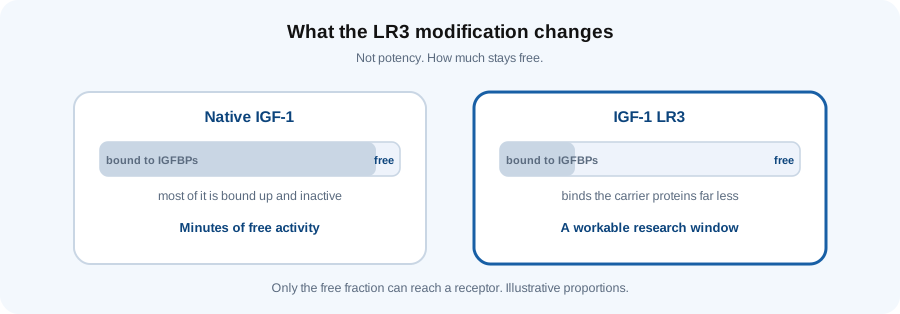
IGF binding proteins, usually shortened to IGFBPs, are carrier proteins that latch onto circulating IGF-1. They serve a purpose: they protect it from being cleared immediately and they regulate how much is available. The consequence is that the large majority of IGF-1 in circulation is bound at any moment, and bound IGF-1 cannot reach a receptor. Only the free fraction is active.
Native IGF-1 is therefore difficult to study. Its free half-life is measured in minutes, and how much is free depends on how much binding capacity happens to be available, which varies. The LR3 modification reduces that binding affinity, so more of the compound stays free and stays free for longer. That is the whole engineering rationale.
Longer is not stronger
The most common claim about IGF-1 LR3 is that it is a more potent version of IGF-1. It is not, and the distinction is worth being precise about because it changes how results should be read.
Potency describes how strongly a molecule activates its receptor. The LR3 modifications do not alter the receptor-binding region, so at the receptor itself IGF-1 LR3 behaves like IGF-1. What changed is availability: more free molecule, present for longer. More of it reaching the receptor is not the same as each molecule doing more when it arrives.
Practically this also means IGF-1 LR3 is more predictable to work with than native IGF-1, because you are not trying to account for variable binding protein capacity deciding how much of your compound is actually active.
Where it sits in the GH axis
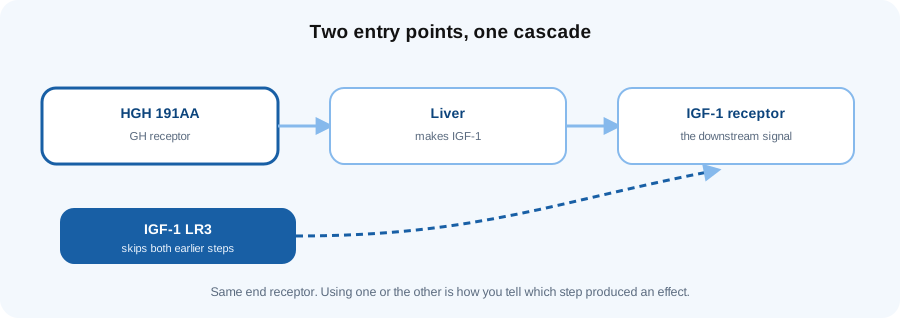
The growth hormone axis is a chain, and every compound in this part of the range plugs in at a different link. IGF-1 LR3 is the last one.
| Stage | What acts there | PhaseOne range |
|---|---|---|
| Receptor signalling | GHRH and ghrelin receptor agonists | Ipamorelin, CJC-1295, Tesamorelin |
| The hormone itself | Growth hormone analogue | HGH 191AA |
| Downstream mediator | IGF-1 analogue | IGF-1 LR3 |
A secretagogue asks the pituitary to release growth hormone. Growth hormone asks the liver to make IGF-1. IGF-1 acts on its receptor. IGF-1 LR3 starts at the last step, which is precisely what makes it useful: if an effect appears with a secretagogue and also with IGF-1 LR3, the IGF-1 receptor is implicated. If it appears with one and not the other, it is not.
See the Ipamorelin guide , the CJC-1295 guide and the growth hormone peptide guide for the upstream links.

IGF-1 LR3 vs HGH 191AA
These two are the pair most often set against each other, and the difference is not subtle once the cascade is clear.
| IGF-1 LR3 | HGH 191AA | |
|---|---|---|
| Receptor | IGF-1 receptor | GH receptor |
| Position in the chain | Last link | Two links earlier |
| Liver involvement | None required | Needed to produce IGF-1 |
| Relationship to IGF-1 | Is the IGF-1 analogue | Causes IGF-1 to be made |
| Other GH effects | Not reproduced | Present, GH does more than raise IGF-1 |
The last row matters and is usually left out. Growth hormone does several things, only some of which run through IGF-1. So HGH 191AA and IGF-1 LR3 are not interchangeable in either direction: IGF-1 LR3 does not reproduce GH's non-IGF-1 effects, and HGH does not give you a clean IGF-1 receptor signal.
Not the only modified IGF-1
LR3 is one way to modify IGF-1, not the only one. Des(1-3)IGF-1 is another that appears in the literature, made by removing the first three residues rather than adding to them, and it has its own pharmacokinetic profile.
The practical warning: all of these get referred to loosely as IGF-1 in casual discussion, and they do not behave identically. Before comparing two studies, check which analogue each used. A result on Des(1-3) is not a result on LR3, and neither is a result on native IGF-1. PhaseOne supplies the LR3 form.
Reconstituting a 1mg vial
IGF-1 LR3 arrives as a lyophilised powder and is reconstituted with bacteriostatic water . At 1mg this is the smallest vial in the range by a wide margin, and research quantities are in micrograms, so how much water you add is the difference between a measurable draw and guesswork. Units are on a 100 unit U-100 syringe.
| Bacteriostatic water added | Concentration | 20mcg draw | 50mcg draw | 100mcg draw |
|---|---|---|---|---|
| 1ml | 1000mcg/ml | 0.02ml, 2 units | 0.05ml, 5 units | 0.10ml, 10 units |
| 2ml | 500mcg/ml | 0.04ml, 4 units | 0.10ml, 10 units | 0.20ml, 20 units |
| 3ml | 333mcg/ml | 0.06ml, 6 units | 0.15ml, 15 units | 0.30ml, 30 units |
| 4ml | 250mcg/ml | 0.08ml, 8 units | 0.20ml, 20 units | 0.40ml, 40 units |
Diluting further than you would for a 10mg vial is the right instinct here. At 1ml a 20mcg draw is two syringe units, where a single unit misread is a 50% error. 3ml to 4ml puts the same amount into a range you can actually read. Work out any combination with the peptide dosage calculator , and see the reconstitution guide for technique.
Add the water slowly down the vial wall, swirl rather than shake, then refrigerate once dissolved and keep it out of light. The storage guide covers the stability variables in full.
What the research does not establish
Four limits, and the first is the one most often missed.
- Findings on IGF-1 LR3 do not transfer to native IGF-1. The whole point of the modification is that the pharmacokinetics differ, so a result produced under sustained free exposure says little about a hormone that is normally bound and cleared in minutes.
- IGF-1 LR3 specific human clinical data is limited. The large IGF-1 literature is mostly about the native hormone.
- Bypassing the upstream cascade is a methodological advantage and a limitation at once: you get a clean IGF-1 receptor signal and you lose everything else growth hormone does.
- Muscle tissue and insulin-signalling threads are the better developed parts of the literature, and both are animal-model and in-vitro.
The structural similarity between the IGF-1 and insulin receptor families is also why insulin signalling keeps appearing in this research, and why conclusions in that area should be read carefully rather than assumed.
Checking purity before you order
IGF-1 LR3 has a verification problem specific to it. The thing you are paying for is the modification, and a purity percentage says nothing about whether the modification is present. A batch could be 99% pure native IGF-1 and the certificate would look fine.
So the question to ask is whether the certificate confirms identity, meaning the 83 residue modified sequence, rather than only reporting a purity figure. That matters more here than for almost anything else in the catalogue.
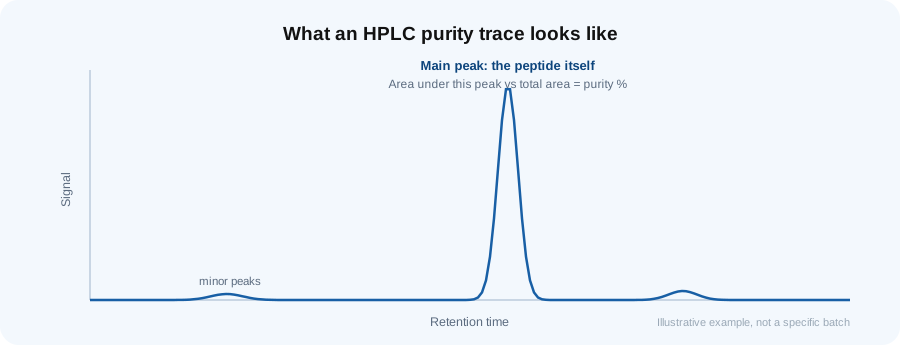
Every PhaseOne batch is independently tested to a standard of at least 99% purity by HPLC, and the certificate for each batch is published in our public COA library . You can read the result before ordering rather than taking a claim on trust. No COA is shipped with the vial; it is simply public.
For how to read a chromatogram, see the HPLC testing guide , and for what any supplier should be able to show you, the research standards guide .
Buying IGF-1 LR3 in Australia
PhaseOne supplies IGF-1 LR3 in 1mg vials from Australian stock, shipped Australia-wide, for laboratory research only, with every batch HPLC tested to at least 99% purity and the certificate published publicly.
Three checks against any Australian supplier. Does the certificate identify the LR3 modified sequence rather than just quoting purity? Is it batch-specific rather than a generic sample? And is the stock held locally or drop-shipped from overseas, which matters more here than for most compounds because growth factors are less forgiving of a broken cold chain than small peptides.
Researchers working the upstream end of the same axis usually pair it with HGH 191AA or a secretagogue as a comparator. Browse the full research range .
Related research guides
For the link above it in the chain, the HGH 191AA guide . For the upstream secretagogues, the Ipamorelin guide , the CJC-1295 guide and the Tesamorelin guide . For the whole axis, the growth hormone peptide guide . For handling, the reconstitution guide and storage guide . For verification, the HPLC testing guide and the COA library .
Frequently Asked Questions
What does LR3 stand for?
Long Arginine 3. Long refers to a 13 amino acid extension added at one end, and Arginine 3 refers to an arginine substituted in at the third position. Both changes reduce how strongly the molecule binds IGF binding proteins.
What is IGF-1 LR3 in simple terms?
An 83 amino acid analogue of insulin-like growth factor 1, which is 70 amino acids natively. The two modifications leave the receptor-binding region alone and simply stop carrier proteins from sequestering it.
Is LR3 IGF-1 the same as IGF-1 LR3?
Yes. IGF-1 LR3, LR3 IGF-1, Long R3 IGF-1 and LR3 all refer to the same compound.
What are IGF binding proteins?
Carrier proteins that latch onto circulating IGF-1. They protect it from clearance and regulate availability, but bound IGF-1 cannot reach a receptor, so only the free fraction is active. Most native IGF-1 is bound at any moment.
Is IGF-1 LR3 more potent than native IGF-1?
No. Potency describes how strongly a molecule activates its receptor, and the LR3 changes do not touch the receptor-binding region. What changed is availability: more of it stays free, for longer.
Why does IGF-1 LR3 last longer than native IGF-1?
Because reduced binding protein affinity means less of it is captured. Native IGF-1 has a free half-life of minutes; the modification is specifically designed to extend that window.
How is IGF-1 LR3 different from HGH 191AA?
Position in the chain. HGH 191AA acts on the GH receptor and prompts the liver to make IGF-1. IGF-1 LR3 is the IGF-1 analogue itself and acts on the IGF-1 receptor directly, skipping both earlier steps.
Can IGF-1 LR3 replace HGH in research?
No, in either direction. Growth hormone does several things and only some of them run through IGF-1, so IGF-1 LR3 does not reproduce the rest, and HGH does not give a clean IGF-1 receptor signal.
Where does IGF-1 LR3 sit relative to Ipamorelin and CJC-1295?
Furthest downstream. Secretagogues ask the pituitary for growth hormone, growth hormone asks the liver for IGF-1, and IGF-1 acts on its receptor. IGF-1 LR3 starts at the last step.
What is Des(1-3)IGF-1 and is it the same thing?
A different modified IGF-1, made by removing the first three residues rather than adding an extension. It has its own pharmacokinetics. Before comparing two studies, check which analogue each used.
Do IGF-1 LR3 findings apply to native IGF-1?
Not directly. The modification exists precisely to change the pharmacokinetics, so results produced under sustained free exposure say little about a hormone normally bound and cleared within minutes.
What research is IGF-1 LR3 used in?
Mainly muscle tissue signalling models and metabolic research into the overlap between IGF-1 and insulin receptor signalling, given the structural similarity between those receptor families. Both threads are animal-model and in-vitro.
What vial size does IGF-1 LR3 come in?
1mg of lyophilised powder, the smallest vial in the PhaseOne range. Research quantities are in micrograms.
How much bacteriostatic water should a 1mg IGF-1 LR3 vial be reconstituted with?
More than you would use for a 10mg vial. 3ml to 4ml gives 333mcg/ml or 250mcg/ml, which keeps microgram draws in a readable range. At 1ml a 20mcg draw is two syringe units, where a one unit misread is a 50% error.
How should IGF-1 LR3 be stored?
Lyophilised vials refrigerated and out of light. Once reconstituted, refrigerate immediately and keep it dark. Growth factors are less forgiving of a broken cold chain than small peptides, so locally held stock matters more here.
How is IGF-1 LR3 purity verified?
By independent HPLC testing. The important point is that purity alone is not enough here: a batch could be highly pure native IGF-1 and the figure would look fine, so ask whether the certificate confirms the modified 83 residue sequence.
What purity is PhaseOne IGF-1 LR3?
At least 99% by independent HPLC testing, with the certificate for each batch published in our public COA library.
Does a COA come with the vial?
No. Certificates are not shipped with orders. Every batch certificate is published in our public COA library instead, so anyone can check a result before buying.
Where can I buy IGF-1 LR3 in Australia?
PhaseOne supplies IGF-1 LR3 1mg vials from Australian stock, shipped Australia-wide, for laboratory research only, with batch-specific HPLC certificates published publicly.
Disclaimer
All products supplied by PhaseOne are intended strictly for laboratory research purposes only. Products are not intended for human consumption, therapeutic use, cosmetic use, veterinary use, or diagnostic applications.


