
What Is MOTS-c? Mitochondrial Peptide Research Guide

| Sequence length | 16 amino acids |
|---|---|
| Coded in | Mitochondrial DNA, 12S rRNA region |
| Class | Mitochondrial-derived peptide (MDP) |
| Name expands to | Mitochondrial Open reading frame of the 12S rRNA type-c |
| Also written | MOTS c, motsc, MOTS-c peptide |
| Main studied mechanism | AMPK activation; stress-responsive nuclear translocation |
| Vial sizes | 10mg and 40mg lyophilised powder |
| Purity | Greater than or equal to 99% by HPLC, batch certificate published publicly |
| Research maturity | Recent; predominantly cell culture and animal-model, human research very limited |
MOTS-c vs GLP-1 class compounds
| MOTS-c | GLP-1 class, e.g. Retatrutide | |
|---|---|---|
| Where it acts | Inside the cell | On the cell surface |
| Origin | Coded in mitochondrial DNA | Synthetic hormone analogue |
| Mechanism | AMPK energy sensing | Incretin receptor agonism |
| Length | 16 amino acids | 39 amino acids |
| Studied for | Cellular energy metabolism | Appetite and glucose regulation |
| Research base | Recent, mostly pre-clinical | Includes human trial data |
MOTS-c is a 16 amino acid peptide with an origin almost nothing else in this catalogue shares: it is coded inside mitochondrial DNA rather than in the cell nucleus. Mitochondria were assumed for decades to code only the handful of proteins they need for energy production, so finding a functional signalling peptide hidden in the 12S rRNA region opened a research category that did not previously exist.
It is written MOTS-c, MOTS c, MOTS-c peptide and often just motsc. This guide covers where it comes from and why that matters, what AMPK actually is, why it behaves as a stress signal rather than a constant one, how it differs from the GLP-1 compounds it gets lumped in with, reconstitution volumes for the 10mg and 40mg vials, and how to check a batch. MOTS-c is supplied by PhaseOne in 10mg and 40mg vials, strictly for laboratory research.
On this page
What is MOTS-c | Why the origin matters | What AMPK is | A stress signal | vs GLP-1 compounds | Other MDPs | Reconstitution | Checking purity | FAQs
Key points at a glance
- A 16 amino acid peptide coded in mitochondrial DNA, in the 12S rRNA region
- Written MOTS-c, MOTS c, motsc and MOTS-c peptide; all the same compound
- One of a small class called mitochondrial-derived peptides, or MDPs
- Studied for activating AMPK, the cell's energy sensing pathway
- Studied for moving into the nucleus under metabolic stress, which is the least settled part
- Appears to respond to stress rather than sit at a constant level
- Mechanistically unrelated to GLP-1 compounds despite both being called metabolic
- The research base is recent and predominantly cell culture and animal-model
- Supplied in 10mg and 40mg vials, at least 99% HPLC purity, certificate published publicly
What is MOTS-c?
MOTS-c stands for Mitochondrial Open reading frame of the Twelve S rRNA type-c. The name is doing real work: it tells you the peptide is coded in mitochondrial DNA, and specifically inside the gene for the mitochondrial ribosome's small subunit RNA.
That is an odd place to find a gene. The 12S rRNA region was catalogued long ago as coding a structural RNA, not a peptide, and the open reading frame sitting inside it went unannotated for years. MOTS-c came out of genomic work that went back and looked.
| Property | MOTS-c |
|---|---|
| Sequence length | 16 amino acids |
| Coded in | Mitochondrial DNA, 12S rRNA region |
| Class | Mitochondrial-derived peptide (MDP) |
| Name expands to | Mitochondrial Open reading frame of the 12S rRNA type-c |
| Also written | MOTS c, motsc, MOTS-c peptide |
| Main studied mechanism | AMPK activation; stress-responsive nuclear translocation |
| Vial sizes supplied | 10mg and 40mg lyophilised powder |
| Purity standard | Greater than or equal to 99% by HPLC |
What PhaseOne supplies is synthesised, not extracted. The sequence matches the natural peptide; the manufacturing route is ordinary peptide synthesis.
Why the mitochondrial origin matters
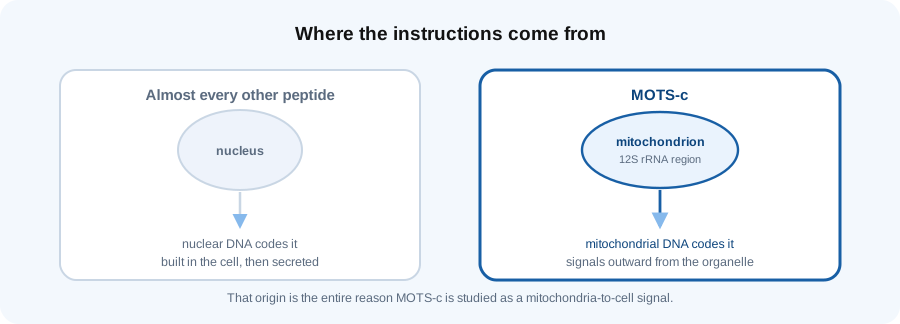
Nearly every other peptide in this catalogue is coded in nuclear DNA, assembled in the cell, then sent somewhere to act. MOTS-c starts inside the organelle that handles energy production.
That placement is the whole research rationale rather than a piece of trivia. A peptide coded inside the mitochondria is positioned to report on the cell's energy state outward, to the rest of the cell and to the nucleus. Researchers call that retrograde signalling, meaning information travelling from organelle to nucleus rather than the usual direction.
Whether MOTS-c genuinely performs that role at a level that matters physiologically is the open question. The position makes the hypothesis worth testing; it does not settle it.
What AMPK is and why it comes up
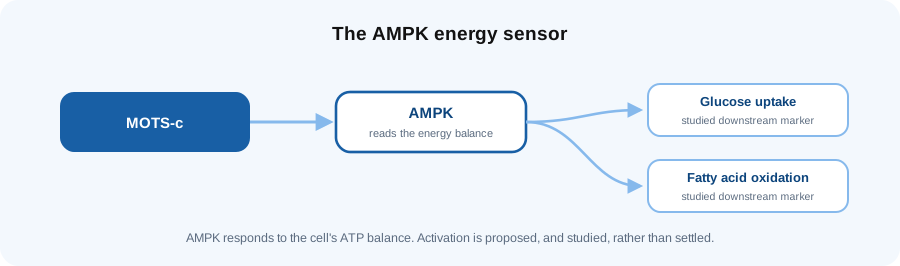
AMPK is an enzyme that reads the ratio of ATP to AMP in a cell, which is a direct measure of whether energy is plentiful or short. When ATP falls, AMPK activates and shifts the cell toward generating energy rather than storing it.
Most of the MOTS-c literature concerns its proposed activation of that pathway, with glucose uptake and fatty acid oxidation as the downstream markers usually measured. The reason this is interesting rather than routine is the loop it implies: a peptide from the mitochondria activating the sensor that governs cellular energy policy.
Note the word proposed. AMPK activation by MOTS-c is the most replicated finding in its literature and still the subject of active investigation rather than a closed question.
A stress signal, not a constant one
One characteristic separates MOTS-c from most peptides studied here. Its levels and its movement within the cell appear to increase under metabolic stress in some research models, rather than sitting at a steady baseline.
Part of that research examines MOTS-c moving into the nucleus under stress, where it is proposed to interact with transcription factors involved in metabolic and antioxidant gene expression. This nuclear thread is the most actively investigated and the least settled part of the mechanism.
The practical consequence for research design is significant. A compound whose own behaviour depends on the stress state of the system is harder to study than one with a flat baseline, because the condition you are measuring in changes what you are measuring. It also means AMPK's established role in exercise-induced metabolic adaptation is why exercise physiology models keep appearing in this literature.
MOTS-c vs GLP-1 compounds
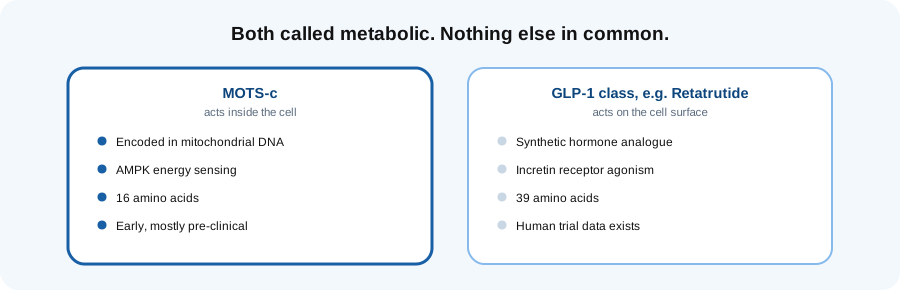
MOTS-c gets grouped with Retatrutide and the rest of the GLP-1 class under the heading metabolic peptides. The heading is the only thing they share.
| MOTS-c | GLP-1 class, e.g. Retatrutide | |
|---|---|---|
| Where it acts | Inside the cell | On the cell surface |
| Origin | Coded in mitochondrial DNA | Synthetic hormone analogue |
| Mechanism | AMPK energy sensing | Incretin receptor agonism |
| Length | 16 amino acids | 39 amino acids |
| Studied for | Cellular energy metabolism | Appetite and glucose regulation |
| Research base | Recent, mostly pre-clinical | Includes human trial data |
One works on receptors on the outside of cells, mimicking gut hormone signalling. The other works inside, on an energy sensor. Neither is a substitute or an alternative for the other, and a finding about one says nothing about the other. The MOTS-c and GLP-1 comparison sets both mechanisms out in full, and the metabolic peptide guide covers the wider category.
MOTS-c also comes up next to NAD+ , which is closer in spirit since both concern cellular energy, but NAD+ is a coenzyme rather than a peptide and the two are not the same kind of thing either.
Other mitochondrial-derived peptides
MOTS-c is the most studied MDP but not the only one. Humanin was characterised earlier and also comes from mitochondrial DNA, with its own proposed roles, and further MDPs have since been described.
The category is young enough that MOTS-c being the furthest along mechanistically says more about how little work exists overall than about how well understood it is. PhaseOne supplies MOTS-c; humanin is not part of the range.
Reconstituting a MOTS-c vial
MOTS-c arrives as a lyophilised powder and is reconstituted with bacteriostatic water . Both vial sizes are covered below. Units are on a 100 unit U-100 syringe.
| Vial | Bacteriostatic water | Concentration | 1mg draw | 5mg draw |
|---|---|---|---|---|
| 10mg | 1ml | 10mg/ml | 0.10ml, 10 units | 0.50ml, 50 units |
| 10mg | 2ml | 5mg/ml | 0.20ml, 20 units | 1.00ml, 100 units |
| 40mg | 2ml | 20mg/ml | 0.05ml, 5 units | 0.25ml, 25 units |
| 40mg | 4ml | 10mg/ml | 0.10ml, 10 units | 0.50ml, 50 units |
Check the vial has the headroom before adding 4ml, since not every vial will take it. The 40mg vial at 20mg/ml produces very small draws, so the lower concentration is easier to measure if the work allows it. Any combination can be worked out with the peptide dosage calculator , and the reconstitution guide covers technique.
Add the water slowly down the vial wall, swirl rather than shake, then refrigerate once dissolved and keep it out of light. Because the 40mg vial holds four times as much, it stays in solution longer once opened, which makes the storage guide more relevant for that size than the smaller one.
What the research does not establish
MOTS-c has the thinnest evidence base of any compound covered in these guides, and it is worth saying so directly rather than dressing a young literature up as an emerging one.
- The nuclear translocation and transcription factor work is under active investigation, not settled. It is the most quoted part of the mechanism and the least secure.
- Human research is very limited. Almost everything is cell culture or animal-model.
- Stress-responsive behaviour makes results harder to compare across studies, because the state of the model changes the readout.
- Claims about human metabolic outcomes circulating in research discussion are not supported by the primary literature as it currently stands.
None of that makes MOTS-c uninteresting. It makes it early, which is a different thing, and a supplier presenting early work as established is the signal to watch for.
Checking purity before you order
MOTS-c has a practical verification problem the older peptides do not. Because the compound is recent, there is less accumulated analytical reference data and fewer established supplier norms, so batch documentation varies more widely than for something like BPC-157.
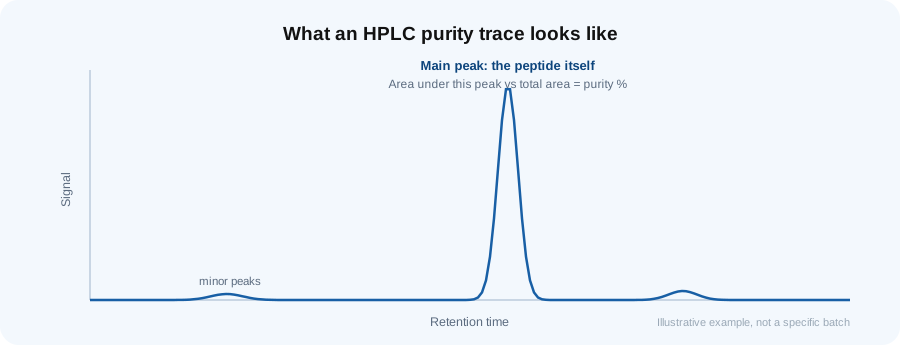
That makes the certificate the only thing worth trusting. Every PhaseOne batch is independently tested to a standard of at least 99% purity by HPLC, and the certificate for each batch is published in our public COA library . You can read the result before ordering rather than taking a purity claim on trust. No COA is shipped with the vial; it is simply public.
For how to read a chromatogram, see the HPLC testing guide , and for what any supplier should be able to show you, the research standards guide .
Buying MOTS-c in Australia
PhaseOne supplies MOTS-c in 10mg and 40mg vials from Australian stock, shipped Australia-wide, for laboratory research only, with every batch HPLC tested to at least 99% purity and the certificate published publicly.
The 40mg vial brings the cost per milligram down considerably, which suits longer work, at the cost of holding a reconstituted vial for longer. For a first evaluation of the compound the 10mg vial is the sensible starting point.
Three checks against any Australian MOTS-c supplier. Is the certificate batch-specific rather than a generic sample? Does it identify the 16 amino acid sequence rather than just quoting a purity figure? And is the stock held locally or drop-shipped from overseas, which affects both transit time and the cold chain. Browse the full research range .
Related research guides
For the mechanism comparison, the MOTS-c and GLP-1 guide . For the compound most often confused with it on energy grounds, the NAD+ guide . For the GLP-1 side, the Retatrutide guide . For the category, the metabolic peptide guide . For handling, the reconstitution guide and storage guide . For verification, the HPLC testing guide and the COA library .
Frequently Asked Questions
What does MOTS-c stand for?
Mitochondrial Open reading frame of the Twelve S rRNA type-c. The name describes where the peptide is coded: inside mitochondrial DNA, in the gene region for the mitochondrial ribosome's small subunit RNA.
What is MOTS-c in simple terms?
A 16 amino acid peptide coded in mitochondrial DNA rather than in the cell nucleus, studied for activating AMPK and for moving into the nucleus under metabolic stress.
Is motsc the same as MOTS-c?
Yes. MOTS-c, MOTS c, motsc and MOTS-c peptide all refer to the same compound. The hyphen is frequently dropped.
Why is the mitochondrial origin a big deal?
Because almost every other peptide is coded in nuclear DNA. A peptide coded inside the energy-producing organelle is positioned to report the cell's energy state outward, which is the hypothesis the whole field rests on.
What is AMPK?
An enzyme that reads the ratio of ATP to AMP in a cell, which indicates whether energy is plentiful or short. When it activates, the cell shifts toward generating energy rather than storing it.
Is MOTS-c proven to activate AMPK?
AMPK activation is the most replicated finding in its literature, but it is still described as proposed and remains under active investigation rather than closed.
Why does MOTS-c respond to stress?
Its levels and its movement inside the cell appear to increase under metabolic stress in some models, which suggests it is part of a response system rather than a constant background signal. That is one of its more distinctive characteristics.
Is MOTS-c the same category as GLP-1 peptides like Retatrutide?
No. MOTS-c works inside the cell on an energy sensor; GLP-1 compounds work on receptors on the cell surface, mimicking gut hormone signalling. They share the word metabolic and nothing else.
How does MOTS-c compare with NAD+?
Both concern cellular energy, which is why they come up together, but NAD+ is a coenzyme rather than a peptide and the mechanisms are different. Neither substitutes for the other.
Are there other mitochondrial-derived peptides?
Yes. Humanin was characterised earlier and also comes from mitochondrial DNA, and further MDPs have since been described. PhaseOne supplies MOTS-c only.
Is MOTS-c synthetic or extracted?
What PhaseOne supplies is synthesised by ordinary peptide synthesis. The sequence matches the natural peptide; nothing is extracted from mitochondria.
How well established is MOTS-c research?
It is the thinnest evidence base of any compound in these guides. Human research is very limited and almost everything is cell culture or animal-model work.
What vial sizes does MOTS-c come in?
10mg and 40mg. The 40mg vial lowers the cost per milligram for longer work; the 10mg is the sensible size for a first evaluation.
How much bacteriostatic water should a MOTS-c vial be reconstituted with?
For the 10mg vial, 1ml to 2ml gives 10mg/ml or 5mg/ml. For the 40mg vial, 2ml gives 20mg/ml and 4ml gives 10mg/ml, if the vial has the headroom. The table above converts each option to syringe units.
How should MOTS-c be stored?
Lyophilised vials refrigerated and out of light. Once reconstituted, refrigerate immediately and keep it dark. The 40mg vial stays in solution longer once opened, so storage conditions matter more for that size.
How is MOTS-c purity verified?
By independent HPLC testing. Because the compound is recent there is less accumulated analytical reference data than for older peptides, so batch documentation varies more between suppliers and the certificate matters more.
What purity is PhaseOne MOTS-c?
At least 99% by independent HPLC testing, with the certificate for each batch published in our public COA library.
Does a COA come with the vial?
No. Certificates are not shipped with orders. Every batch certificate is published in our public COA library instead, so anyone can check a result before buying.
Where can I buy MOTS-c peptide in Australia?
PhaseOne supplies MOTS-c in 10mg and 40mg vials from Australian stock, shipped Australia-wide, for laboratory research only, with batch-specific HPLC certificates published publicly.
Disclaimer
All products supplied by PhaseOne are intended strictly for laboratory research purposes only. Products are not intended for human consumption, therapeutic use, cosmetic use, veterinary use, or diagnostic applications.


