
What Is NAD+? NAD Research Guide Australia

| Full name | Nicotinamide adenine dinucleotide |
|---|---|
| CAS number | 53-84-9 |
| Molecular formula | C21H27N7O14P2 |
| Classification | Dinucleotide coenzyme, not a peptide |
| Forms | NAD+ (oxidised) and NADH (reduced) |
| Key research areas | Mitochondrial energy production, sirtuin activation (SIRT1-7), PARP DNA repair |
| Vial size | 1000mg lyophilised powder |
| Purity | Greater than or equal to 99% by HPLC, batch certificate published publicly |
| Research maturity | Settled cellular biochemistry; longevity applications remain an open question |
NAD+ vs NMN vs NR
| NAD+ | NMN | NR | |
|---|---|---|---|
| What it is | The coenzyme itself | Direct NAD+ precursor | Precursor one step further back |
| Route to NAD+ | Already NAD+ | One enzymatic step | Two enzymatic steps |
| Research question | Direct availability and use | Whether conversion raises the pool | Whether conversion raises the pool |
| Common form sold | Research vial | Oral supplement | Oral supplement |
| Supplied by PhaseOne | Yes, 1000mg vial | No | No |
NAD+ stands for nicotinamide adenine dinucleotide. It is a coenzyme that sits in every living cell, where it carries electrons through mitochondrial energy production and acts as the required fuel for two enzyme families, the sirtuins and the PARP DNA-repair enzymes. That is why it turns up in almost every conversation about cellular energy and ageing.
It is searched for as NAD, NAD+, NAD peptide and NAD compound, and the first thing worth clearing up is that it is not a peptide at all. This guide covers what NAD+ actually is, the three things it does in a cell, why levels fall with age, how a research vial differs from an oral NAD supplement, how NAD+ compares with NMN, NR and MOTS-c, reconstitution volumes for a 1000mg vial, and how to check a batch. NAD+ is supplied by PhaseOne in 1000mg vials, strictly for laboratory research.
On this page
What is NAD+ | Is NAD+ a peptide | What it does in a cell | NAD+ and age | Vial vs supplement | vs NMN and NR | vs MOTS-c | Reconstitution | Checking purity | FAQs
Key points at a glance
- NAD+ is a dinucleotide coenzyme, CAS 53-84-9, formula C21H27N7O14P2
- Written NAD, NAD+, NAD plus and sometimes NAD compound; all refer to the same molecule
- Not a peptide, despite being listed as NAD peptide by most suppliers
- Cycles between NAD+ and NADH as an electron carrier in mitochondrial ATP production
- Required substrate for the sirtuin enzymes SIRT1 through SIRT7
- Required substrate for PARP enzymes involved in DNA repair signalling
- Cellular levels decline with age across multiple research models, which is the basis of the longevity interest
- A research vial is not an NAD supplement, and the two are not interchangeable
- Supplied in 1000mg vials for laboratory research only
What is NAD+?
NAD+ is built from two nucleotides joined through their phosphate groups. One carries an adenine base, the other carries nicotinamide, which is a form of vitamin B3. That pairing is where the name comes from: nicotinamide adenine dinucleotide.
It exists in two forms that convert back and forth. NAD+ is the oxidised form, which accepts electrons. NADH is the reduced form, which carries them. A cell runs that cycle continuously, which is why the same molecule shows up in metabolism, in enzyme signalling and in DNA repair.
| Property | NAD+ |
|---|---|
| Full name | Nicotinamide adenine dinucleotide |
| CAS number | 53-84-9 |
| Molecular formula | C21H27N7O14P2 |
| Class | Dinucleotide coenzyme |
| Forms | NAD+ (oxidised) and NADH (reduced) |
| Vial size supplied | 1000mg lyophilised powder |
| Purity standard | Greater than or equal to 99% by HPLC |
Is NAD+ a peptide?
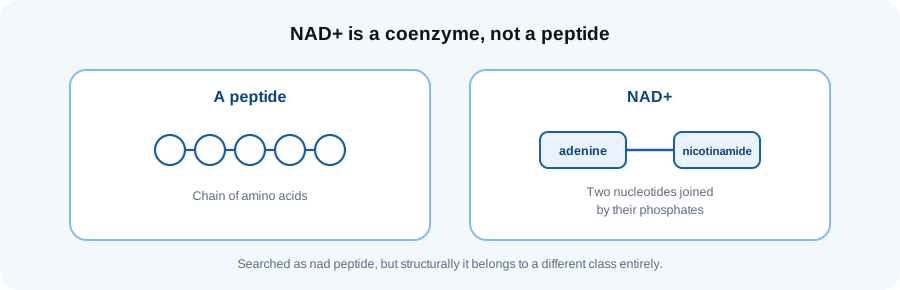
No. A peptide is a chain of amino acids linked by peptide bonds. NAD+ has no amino acids and no peptide bonds; it is two nucleotides joined by phosphates. Structurally it belongs to a different class entirely.
The reason nearly every supplier, including this page's own title history, lists it as NAD peptide or NAD+ peptide is simply that researchers search for it that way. It sits in the same catalogues, ships in the same lyophilised vials and gets handled with the same reconstitution process, so the label stuck. It is still worth knowing which it is, because it changes which literature applies: NAD+ papers sit in metabolism and biochemistry journals, not in the peptide literature.
If you came here searching NAD peptide Australia, you are in the right place. The product is the same one. The classification is just more precise than the search term.
What NAD+ does in a cell
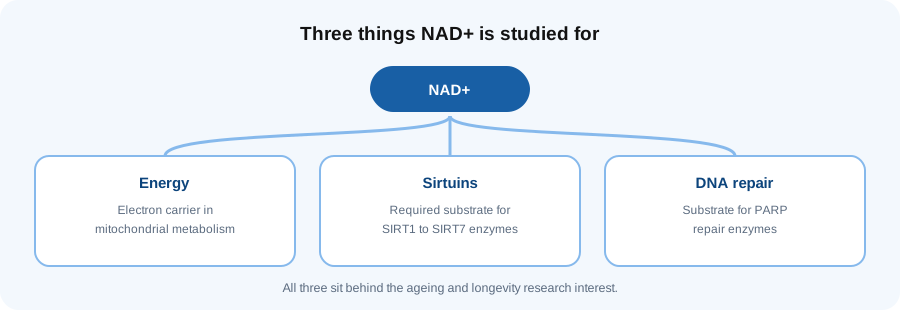
Three roles account for most of the research, and they are connected: all three consume or recycle the same pool of NAD+, so anything that drains one affects the others.
Mitochondrial energy production
NAD+ and NADH shuttle electrons into the electron transport chain, the mitochondrial process that produces most of a cell's ATP. No NAD+ pool, no electron handoff, no ATP at normal output. This is the least speculative part of the NAD+ story: it is textbook biochemistry rather than an open research question.
Sirtuin activation, SIRT1 to SIRT7
The sirtuins are a family of seven enzymes studied for their involvement in metabolic regulation, stress resistance and ageing-related signalling. They are NAD+ dependent, meaning they consume NAD+ as a substrate every time they act. When NAD+ availability drops, sirtuin activity drops with it.
That dependency is the whole mechanistic basis for the longevity research interest. It is also where the claims get stretched, because a change in sirtuin activity in a cell line is a long way from an outcome in an organism.
PARP enzymes and DNA repair
PARP enzymes detect DNA strand breaks and signal for repair, and they too consume NAD+ to do it. In research models with heavy DNA damage, PARP activity has been observed to draw down the cellular NAD+ pool, which then shows up downstream as reduced sirtuin activity and reduced energy output. It is one pool serving three jobs.
Why NAD+ levels fall with age
Cellular NAD+ has been observed to decline with age across multiple research models. Two mechanisms are commonly proposed: reduced synthesis through the salvage pathway, and increased consumption by PARP enzymes and other NAD+ consuming enzymes as cumulative DNA damage rises.
That observation is what drives the research and the public interest alike. It is worth being precise about what it does and does not show. A measured decline in NAD+ is a correlation with age, not a demonstrated cause of ageing, and restoring a level in a model organism is not the same as restoring a function in a person.
Research vial vs NAD supplement
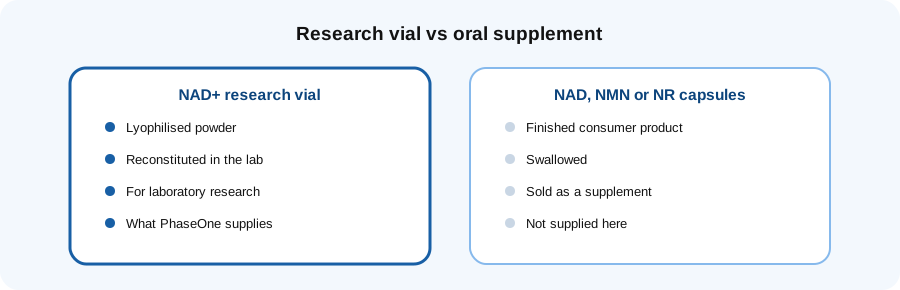
Most of the search traffic around NAD is for supplements: NAD supplement, NAD plus supplement, NAD+ supplement Australia. Those are finished consumer products, usually capsules containing NAD, NMN or NR, sold to be swallowed. They are regulated as supplements and sold through supplement retailers.
What PhaseOne supplies is a different thing. A 1000mg NAD+ research vial is lyophilised powder, reconstituted in a lab, intended for laboratory research only. It is not a supplement, it is not sold as one, and it is not for human consumption.
If you are looking for an oral NAD supplement in Australia, a research supplier is the wrong place to buy and this page is not the right guide. If you are sourcing NAD+ for research work, the 1000mg vial is the listing you want.
NAD+ vs NMN and NR
NMN (nicotinamide mononucleotide) and NR (nicotinamide riboside) are precursors. Neither is NAD+; both are molecules a cell can convert into NAD+ through its salvage pathway. Most of the consumer supplement market sells precursors rather than NAD+ itself, which is why the three names get used interchangeably when they should not be.
| NAD+ | NMN | NR | |
|---|---|---|---|
| What it is | The coenzyme itself | Direct NAD+ precursor | Precursor one step further back |
| Route to NAD+ | Already NAD+ | One enzymatic step | Two enzymatic steps |
| Molecule size | Largest of the three | Intermediate | Smallest |
| Research question | Direct availability and use | Whether conversion raises the pool | Whether conversion raises the pool |
| Supplied by PhaseOne | Yes, 1000mg vial | No | No |
The practical point: a study on NMN is not a study on NAD+. Conversion efficiency, uptake and the route into the cell all differ, and those differences are exactly what the precursor literature is trying to resolve.
NAD+ vs MOTS-c
NAD+ and MOTS-c get grouped together because both are discussed under mitochondrial and metabolic research. The mechanisms have nothing in common.
| NAD+ | MOTS-c | |
|---|---|---|
| Class | Dinucleotide coenzyme | 16 amino acid peptide |
| Origin | Present in every cell | Encoded in mitochondrial DNA |
| Mechanism studied | Electron carrier; sirtuin and PARP substrate | AMPK activation, stress-response signalling |
| Research focus | Cellular energy, DNA repair, longevity | Mitochondrial to nuclear signalling |
| Research base | Extensive, plus precursor literature | Comparatively recent |
A researcher working on mitochondrial function may well look at both, but they answer different questions. For the wider category, see the metabolic peptide guide and the MOTS-c and GLP-1 comparison .
Reconstituting a 1000mg NAD+ vial
NAD+ arrives as a lyophilised powder and is reconstituted with bacteriostatic water . A 1000mg vial is a much larger mass than a typical 5mg or 10mg peptide vial, so the concentrations are correspondingly higher and the volumes drawn are small. Units below are on a 100 unit U-100 syringe.
| Bacteriostatic water added | Concentration | 50mg draw | 100mg draw |
|---|---|---|---|
| 2ml | 500mg/ml | 0.10ml, 10 units | 0.20ml, 20 units |
| 3ml | 333mg/ml | 0.15ml, 15 units | 0.30ml, 30 units |
| 5ml | 200mg/ml | 0.25ml, 25 units | 0.50ml, 50 units |
| 10ml | 100mg/ml | 0.50ml, 50 units | 1.00ml, 100 units |
Add the water slowly down the vial wall rather than directly onto the powder, and let it dissolve without shaking. The full process is in the reconstitution guide , and the peptide dosage calculator will work any concentration you need.
Once reconstituted, refrigerate immediately and keep it out of light. NAD+ in solution is less stable than many peptides, so prepare what the work needs rather than the whole vial. The storage guide covers the stability variables in full.
What the NAD+ research does not establish
Three honest limits, because the gap between the biochemistry and the marketing is wider here than for almost any other compound in this catalogue.
- The cellular role is settled science. The anti-ageing conclusion is not. NAD+ being required for sirtuin and PARP activity does not demonstrate that raising it extends lifespan or reverses age-related decline.
- Most of the human data is on precursors, not on NAD+ itself, and much of it is small and short.
- An observed decline with age is a correlation. Whether it is a driver of ageing or a consequence of it remains an open research question.
Any supplier presenting NAD+ as a proven anti-ageing intervention is going well past what the literature supports.
Checking purity before you order
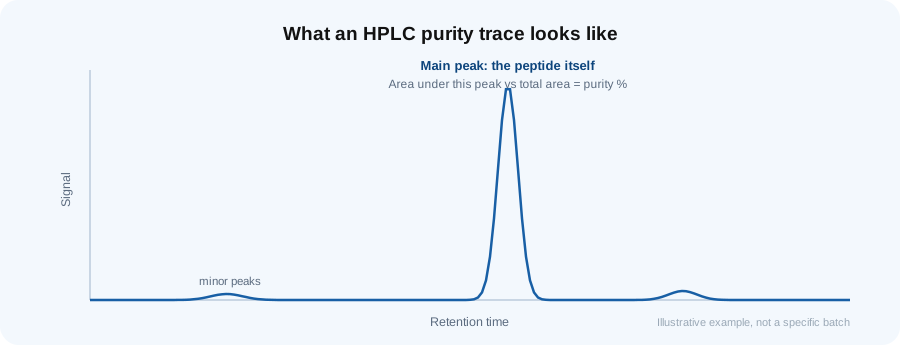
NAD+ is cheap to adulterate with nicotinamide, which is a far less expensive and structurally related compound, so identity testing matters as much as purity testing. The check to ask for is HPLC, which separates a sample by retention time and shows contaminants as separate peaks.
Every PhaseOne batch is independently tested to a standard of at least 99% purity by HPLC, and the certificate for each batch is published in our public COA library . You can read the result for the batch before ordering rather than taking a purity claim on trust. No COA is shipped with the vial; it is simply public.
For how to read a chromatogram, see the HPLC testing guide , and for what a supplier should be able to show you, the research standards guide .
Buying NAD+ in Australia
PhaseOne supplies NAD+ in 1000mg vials from Australian stock, shipped Australia-wide, for laboratory research only. Every batch is HPLC tested to at least 99% purity with the certificate published publicly.
Three things worth checking against any Australian NAD supplier: whether the certificate is batch-specific rather than a generic sample, whether it identifies NAD+ rather than nicotinamide, and whether the stock is held locally or drop-shipped from overseas, which affects both transit time and the cold chain.
Browse the full research range , or start with the metabolic category guide .
Related research guides
For the mitochondrial peptide comparison, see the MOTS-c guide . For the category overview, the metabolic peptide guide . For handling, the reconstitution guide and storage guide . For verification, the HPLC testing guide and the COA library .
Frequently Asked Questions
What does NAD stand for?
NAD stands for nicotinamide adenine dinucleotide. The plus sign in NAD+ marks the oxidised form of the molecule, the one that accepts electrons; the reduced form is written NADH. NAD, NAD+ and NAD plus are all used for the same compound.
Is NAD+ technically a peptide?
No. Peptides are chains of amino acids; NAD+ is two nucleotides joined through their phosphate groups, with no amino acids and no peptide bonds. It is listed as NAD peptide by most suppliers because that is how researchers search for it, but it is a coenzyme.
What does NAD+ do in the body?
It carries electrons through mitochondrial energy production, and it is the required substrate for the sirtuin enzymes SIRT1 to SIRT7 and for the PARP enzymes involved in DNA repair signalling. All three draw on the same cellular pool.
Why is NAD+ linked to ageing research?
Because cellular NAD+ has been observed to decline with age across multiple research models, and because the sirtuins, which are studied for their role in ageing-related signalling, cannot function without it. The link is mechanistically plausible and still an open research question.
What is the difference between NAD+ and NMN?
NMN is a precursor. A cell converts NMN into NAD+ through its salvage pathway, one enzymatic step away. NAD+ is the coenzyme itself. A study on NMN is not a study on NAD+, because conversion and uptake differ.
What is the difference between NAD+ and NR?
NR, nicotinamide riboside, is a precursor that sits one step further back than NMN, so it takes two enzymatic conversions to become NAD+. Like NMN, it is a different compound with a different research question.
Is an NAD research vial the same as an NAD supplement?
No. An oral NAD supplement is a finished consumer product sold to be swallowed, usually containing NAD, NMN or NR. A research vial is lyophilised powder reconstituted in a lab for laboratory research only, and is not for human consumption.
Can I buy an NAD supplement from PhaseOne?
No. PhaseOne supplies NAD+ as a 1000mg research vial for laboratory use only. If you want an oral NAD or NMN supplement, a supplement retailer is the right place to look, not a research supplier.
What vial size does NAD+ come in?
1000mg of lyophilised NAD+ powder. That is a much larger mass than a typical peptide vial, so reconstituted concentrations are high and the volumes drawn are small.
How much bacteriostatic water should a 1000mg NAD+ vial be reconstituted with?
It depends on the concentration the work needs. 2ml gives 500mg/ml, 5ml gives 200mg/ml and 10ml gives 100mg/ml. The table above converts each to draw volumes and syringe units.
How should NAD+ be stored?
Lyophilised vials keep refrigerated and out of light. Once reconstituted, refrigerate immediately and protect from light; NAD+ in solution is less stable than many peptides, so prepare what the work needs rather than the whole vial.
How is NAD+ purity verified?
By HPLC, which separates the sample by retention time so contaminants appear as distinct peaks. This matters particularly for NAD+ because nicotinamide is a cheaper, structurally related compound that can be used to pad a batch.
What purity is PhaseOne NAD+?
At least 99% by independent HPLC testing. The certificate for each batch is published in our public COA library, where you can read it before ordering.
Does a COA come with the vial?
No. Certificates are not shipped with orders. Every batch certificate is published in our public COA library instead, so anyone can check a result before buying.
Is NAD+ the same research category as MOTS-c?
No. Both are discussed under mitochondrial research, but NAD+ is a coenzyme that serves as a substrate for other enzymes, while MOTS-c is a 16 amino acid peptide encoded in mitochondrial DNA and studied for AMPK signalling. The mechanisms are unrelated.
Where can I buy NAD+ in Australia?
PhaseOne supplies NAD+ 1000mg vials from Australian stock, shipped Australia-wide, for laboratory research only, with batch-specific HPLC certificates published publicly.
Disclaimer
All products supplied by PhaseOne are intended strictly for laboratory research purposes only. Products are not intended for human consumption, therapeutic use, cosmetic use, veterinary use, or diagnostic applications.


