
What Is KPV? KPV Peptide Research Guide

| Sequence | Lysine-Proline-Valine |
|---|---|
| Length | 3 amino acids (tripeptide) |
| Derived from | Alpha-MSH, positions 11 to 13 |
| Also written | KPV peptide, alpha-MSH(11-13) |
| Studied for | Anti-inflammatory signalling, independent of melanocortin receptors |
| Key research models | Inflammatory bowel disease models; dermal inflammation models |
| Found in blends | KLOW, as the fourth component |
| Vial size | 10mg lyophilised powder |
| Purity | Greater than or equal to 99% by HPLC, batch certificate published publicly |
| Research maturity | Receptor-independence well supported; downstream mechanism unresolved, animal-model and in-vitro |
KPV vs Melanotan II
| KPV | Melanotan II | |
|---|---|---|
| Relationship to alpha-MSH | Unmodified 3 residue fragment | Synthetic cyclic analogue |
| Length | 3 amino acids | 7 amino acids |
| Melanocortin receptors | Not required | The entire mechanism |
| Studied for | Inflammation signalling | Pigmentation-related signalling |
| Found in blends | KLOW | Not blended |
KPV is three amino acids long: lysine, proline, valine. That is the whole molecule, which makes it one of the smallest compounds anyone studies seriously. It is the tail end of alpha-MSH, the hormone best known for driving pigmentation, and the interesting part is that KPV's anti-inflammatory activity keeps working when the receptors alpha-MSH uses are removed entirely.
It is written KPV, KPV peptide and occasionally alpha-MSH(11-13). This guide covers where it comes from, the knockout experiment that proved it works a different way, why the Melanotan connection misleads people, the gut and skin research, its job in the KLOW blend, reconstitution volumes, and how to check a batch. KPV is supplied by PhaseOne in 10mg vials, strictly for laboratory research.
On this page
What is KPV | The knockout experiment | Why the Melanotan link misleads | What NF-kB is | Gut and skin research | KPV in KLOW | Reconstitution | Checking purity | FAQs
Key points at a glance
- A tripeptide: lysine, proline, valine, three amino acids in total
- The last three residues of alpha-MSH, also written alpha-MSH(11-13)
- Named directly after the single-letter codes for its amino acids: K, P, V
- Studied for anti-inflammatory signalling, not for anything pigmentation-related
- Knockout-model work showed the effect persists without melanocortin receptors
- That receptor-independence is the finding the whole research interest rests on
- Best developed research threads are gut inflammation and skin inflammation models
- The fourth component of the KLOW blend, adding a mechanism the other three lack
- Supplied in 10mg vials, at least 99% HPLC purity, certificate published publicly
What is KPV?
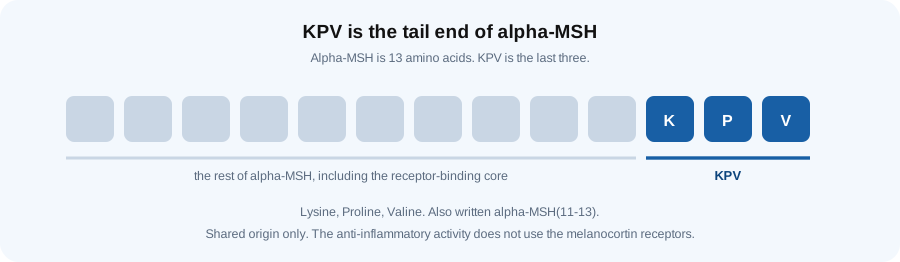
Alpha-MSH, alpha-melanocyte-stimulating hormone, is 13 amino acids long. KPV is positions 11 to 13, the very end of it. Nothing has been added or modified; it is simply that fragment made on its own.
The name is as literal as peptide names get. K is lysine, P is proline, V is valine, using the standard single-letter amino acid codes, so KPV is the sequence written out.
| Property | KPV |
|---|---|
| Sequence | Lysine-Proline-Valine |
| Length | 3 amino acids (tripeptide) |
| Derived from | Alpha-MSH, positions 11 to 13 |
| Also written | KPV peptide, alpha-MSH(11-13) |
| Studied for | Anti-inflammatory signalling, receptor-independent |
| Found in blends | KLOW, as the fourth component |
| Vial size supplied | 10mg lyophilised powder |
| Purity standard | Greater than or equal to 99% by HPLC |
Three amino acids is small enough to change what is practical. Short sequences are cheaper to make consistently and more resistant to being broken apart, which is why KPV has been examined across oral and topical routes as well as injectable, a breadth of delivery research most peptides in this catalogue have never had.
The knockout experiment
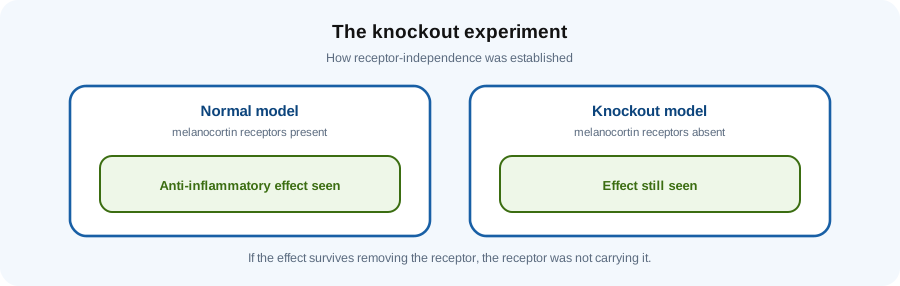
Here is the piece of evidence that made KPV worth studying as its own compound rather than as a curiosity about alpha-MSH.
If a fragment of a hormone has an effect, the obvious explanation is that it is using the hormone's receptors. The way to test that is to remove the receptors. Researchers used animal models genetically engineered to have no functional melanocortin receptors at all, gave them KPV, and the anti-inflammatory effect was still there.
That result does two things. It rules out the obvious explanation, and it means the melanocortin pathway is not the mechanism. Whatever KPV is doing, it is doing it somewhere else.
Why the Melanotan link misleads
KPV and Melanotan II both trace back to alpha-MSH, and people reason from that to the conclusion that they must work alike. They do not.
| KPV | Melanotan II | |
|---|---|---|
| Relationship to alpha-MSH | Unmodified 3 residue fragment | Synthetic cyclic analogue |
| Length | 3 amino acids | 7 amino acids |
| Melanocortin receptors | Not required | The entire mechanism |
| Studied for | Inflammation signalling | Pigmentation-related signalling |
| Found in blends | KLOW | Not blended |
The practical rule: do not carry a finding from one to the other. A Melanotan II result tells you about melanocortin receptor agonism, and the knockout work specifically establishes that KPV does not depend on that. See the Melanotan II guide for that side of the family.
What NF-kB is
If the melanocortin receptors are not the route, what is? The leading candidate in the literature is NF-kB, and the acronym gets quoted far more often than it gets explained.
NF-kB is a transcription factor, meaning a protein that switches genes on. It is one of the main switches for inflammatory genes: when a cell detects a threat, NF-kB activates and the inflammatory response gets transcribed. Some research proposes KPV interferes with that activation directly, which would place its effect upstream of the inflammatory programme rather than mopping up afterwards.
Worth holding loosely. This is one proposed pathway under active investigation, not a settled mechanism, and the receptor-independence is far better established than the explanation for it.
The gut and skin research
Two research threads dominate, and both follow from the same practical fact that KPV is small enough to deliver in ways larger peptides cannot.
The first is inflammatory bowel disease models, where KPV has been studied against colonic inflammation markers. This is the best developed part of its literature, helped by the tripeptide surviving conditions that would destroy a longer chain, which makes oral delivery a realistic thing to test.
The second is dermal inflammation, studied in skin-inflammation models. That thread is why KPV sits alongside GHK-Cu in cosmetic-category research, where an anti-inflammatory mechanism and a tissue-remodelling one get examined together. The cosmetic peptide guide covers that pairing.
Both are animal-model and in-vitro. Neither is human clinical evidence.
KPV in the KLOW blend
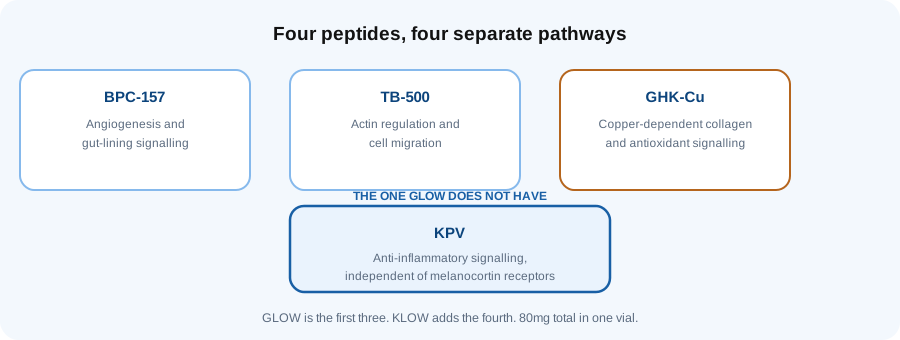
KPV is the K in KLOW , joining BPC-157, TB-500 and GHK-Cu in one vial.
| Component | Mechanism studied for |
|---|---|
| KPV | Inflammation signalling |
| BPC-157 | Angiogenesis and gut-lining signalling |
| TB-500 | Actin binding and cell migration |
| GHK-Cu | Copper-dependent tissue remodelling |
The reason KPV earns its place is that none of the other three address inflammation. Angiogenesis, cytoskeletal remodelling and matrix signalling are three different jobs, and inflammation is a fourth, so adding KPV widens what the blend covers rather than reinforcing what is already there. The KLOW blend is supplied as an 80mg vial.
Reconstituting a 10mg KPV vial
KPV arrives as a lyophilised powder and is reconstituted with bacteriostatic water . Units are on a 100 unit U-100 syringe.
| Bacteriostatic water added | Concentration | 500mcg draw | 1mg draw | 2mg draw |
|---|---|---|---|---|
| 1ml | 10mg/ml | 0.05ml, 5 units | 0.10ml, 10 units | 0.20ml, 20 units |
| 2ml | 5mg/ml | 0.10ml, 10 units | 0.20ml, 20 units | 0.40ml, 40 units |
| 3ml | 3.3mg/ml | 0.15ml, 15 units | 0.30ml, 30 units | 0.60ml, 60 units |
| 5ml | 2mg/ml | 0.25ml, 25 units | 0.50ml, 50 units | 1.00ml, 100 units |
2ml to 3ml is the usual middle ground. Work out any combination with the peptide dosage calculator , and see the reconstitution guide for technique.
Add the water slowly down the vial wall, swirl rather than shake, then refrigerate once dissolved and keep it out of light. The storage guide covers the stability variables in full.
What the research does not establish
The receptor-independence is solid. Most of what gets built on top of it is not.
- The downstream mechanism is unresolved. NF-kB inhibition is a proposal, and it is quoted with far more confidence than the evidence carries.
- The research base is animal-model and in-vitro. Large-scale human clinical data does not exist.
- Anti-inflammatory activity in a colitis model is not a claim about any human condition, and the gap is routinely skipped in marketing copy.
- Delivery-route research showing a tripeptide survives a given route is a pharmacokinetic finding, not evidence that the route produces an outcome.
What KPV genuinely has is an unusually clean negative result, that the melanocortin receptors are not involved. Negative results are valuable and they are not the same as knowing how something works.
Checking purity before you order
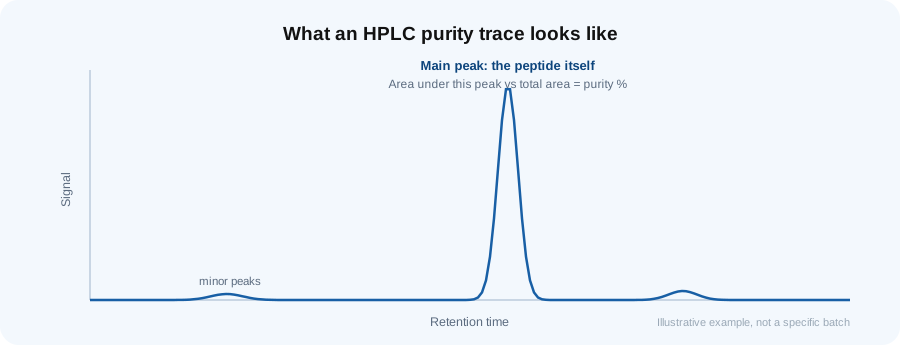
A three amino acid peptide is about as cheap and simple as synthesis gets, which is good for consistency and bad for your ability to tell quality apart on price. The check to ask for is HPLC, which separates a sample by retention time so anything else in the vial shows as its own peak.
Every PhaseOne batch is independently tested to a standard of at least 99% purity by HPLC, and the certificate for each batch is published in our public COA library . You can read the result before ordering rather than taking a purity claim on trust. No COA is shipped with the vial; it is simply public.
For how to read a chromatogram, see the HPLC testing guide , and for what any supplier should be able to show you, the research standards guide .
Buying KPV in Australia
PhaseOne supplies KPV in 10mg vials from Australian stock, shipped Australia-wide, for laboratory research only, with every batch HPLC tested to at least 99% purity and the certificate published publicly.
Two checks worth making on any KPV listing. Does the certificate confirm the three residue sequence rather than just quoting a purity number? And is the stock held locally or drop-shipped from overseas, which affects both transit time and the cold chain.
Researchers studying inflammation alongside tissue repair usually take the KLOW blend instead, which puts KPV in one vial with BPC-157, TB-500 and GHK-Cu. Browse the full research range .
Related research guides
For the blend KPV sits in, the KLOW guide . For the compound it shares an origin with, the Melanotan II guide . For the dermal pairing, the GHK-Cu guide and the cosmetic peptide guide . For the wider category, the regenerative peptide guide . For handling, the reconstitution guide and storage guide . For verification, the HPLC testing guide and the COA library .
Frequently Asked Questions
What is KPV in simple terms?
A tripeptide made of lysine, proline and valine, which are the last three amino acids of alpha-MSH. It is studied for anti-inflammatory signalling that does not depend on the melanocortin receptors.
What does the name KPV mean?
It is the sequence written in single-letter amino acid code: K for lysine, P for proline, V for valine.
Is KPV the same as alpha-MSH(11-13)?
Yes. That is the formal way of writing it, meaning positions 11 to 13 of the alpha-MSH sequence.
How many amino acids is KPV?
Three. That makes it one of the smallest peptides studied seriously, which is why oral and topical delivery have been investigated for it.
Does KPV work the same way as Melanotan II?
No. Both come from alpha-MSH, but Melanotan II's entire mechanism is melanocortin receptor agonism, and knockout research specifically shows KPV does not need those receptors. Do not carry a finding from one to the other.
What is the knockout experiment people refer to?
Animal models engineered to have no functional melanocortin receptors were given KPV, and the anti-inflammatory effect was still observed. That rules out the receptors as the mechanism.
What is NF-kB?
A transcription factor, meaning a protein that switches genes on, and one of the main switches for inflammatory genes. Some research proposes KPV interferes with its activation, which would place the effect upstream of the inflammatory response.
Is the NF-kB mechanism established?
No. It is one proposed pathway under active investigation. The receptor-independence is far better supported than the explanation for it.
Does KPV affect pigmentation?
Its research interest is almost entirely anti-inflammatory. The pigmentation association comes from the parent hormone, not from KPV, and that is the most persistent misconception about this compound.
What research models is KPV studied in?
Mainly inflammatory bowel disease models looking at colonic inflammation markers, and dermal inflammation models. Both are animal-model and in-vitro rather than human clinical.
Why has KPV been studied for oral and topical delivery?
Because three amino acids resist being broken apart in conditions that would destroy a longer chain, so routes that are impractical for most peptides are worth testing here.
Why is KPV in the KLOW blend?
Because none of the other three components address inflammation. BPC-157, TB-500 and GHK-Cu cover angiogenesis, cytoskeletal remodelling and matrix signalling, so KPV widens what the blend covers rather than repeating it.
What vial size does KPV come in?
10mg of lyophilised powder. It is also available inside the 80mg KLOW blend vial.
How much bacteriostatic water should a 10mg KPV vial be reconstituted with?
2ml to 3ml is the usual middle ground, giving 5mg/ml or 3.3mg/ml. The table above converts each option to syringe units.
How should KPV be stored?
Lyophilised vials refrigerated and out of light. Once reconstituted, refrigerate immediately, keep it dark, and prepare only what the work needs.
How is KPV purity verified?
By independent HPLC testing, which separates the sample by retention time so anything else in the vial appears as its own peak. Ask whether the certificate confirms the three residue sequence, not just a purity figure.
What purity is PhaseOne KPV?
At least 99% by independent HPLC testing, with the certificate for each batch published in our public COA library.
Does a COA come with the vial?
No. Certificates are not shipped with orders. Every batch certificate is published in our public COA library instead, so anyone can check a result before buying.
Where can I buy KPV peptide in Australia?
PhaseOne supplies KPV 10mg vials from Australian stock, shipped Australia-wide, for laboratory research only, with batch-specific HPLC certificates published publicly.
Disclaimer
All products supplied by PhaseOne are intended strictly for laboratory research purposes only. Products are not intended for human consumption, therapeutic use, cosmetic use, veterinary use, or diagnostic applications.


